Showing posts with label album of the week. Show all posts

14 July 2008

Album of the Week: Green Carnation - The Burden is Mine... Alone (2005)


I know I'm a bit late--it really should have been written yesterday, but forgive me, I've been distracted--so I'll keep it short this time around.

Green Carnation was a Progressive Metal outfit from Norway. It was composed primarily of members of the now-deceased In The Woods... and two of the more laid-back members of Carpathian Forest. Every one of Green Carnation's releases was a bit different from its predecessor, and The Burden is Mine... Alone, a four-track EP released in 2005, was no exception to this trend. All the "metallic" elements were stripped down to bare-bones acoustics, and The four tracks on the album all feature a discernably melancholic (though hardly despairing) atmosphere.

"The Burden is Mine... Alone" is the first track on the album. It is quite soft, but nonetheless pulls the listener in. "Sweet Leaf" is the second track, and though its faintly martial tempo has the effect of giving it a more upbeat feel than its predecessor, it maintains the melancholy of the album. "Transparent Me" is the third track, an emotional ballad of love lost. "Six Ribbons" closes out the album, and it is an appropriate choice. It is a faux-traditional folk song originally composed by Australian songwriter Jon English. Its folksy composition is simple, but nevertheless Green Carnation's rendition of the song is perhaps the most stirring song on the album.

The first two tracks on this album would reappear on Green Carnation's follow-up LP, Acoustic Verses, which, sadly, would prove to be the band's last effort, as the members went their separate ways in 2007.

Though short, The Burden is Mine... Alone is one the strongest offerings in the Green Carnation discography. It is a moving and satisfying listen.

06 July 2008

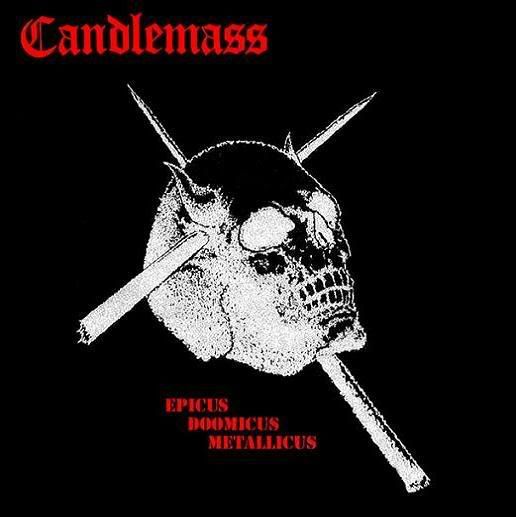
Album of the Week: Candlemass - Epicus Doomicus Metallicus (1986)

Epicus Doomicus Metallicus, dating from 1986, was the debut album from Candlemass. It is also one of the most important and influential albums in all of Doom Metal. It contains only six songs, but every one of these is a classic. Perhaps even moreso than the three other albums that Candlemass released in the 1980s, Epicus Doomicus Metallicus is slow and heavy, moving at the deliberate pace of a thunderstorm on an August afternoon. What really sets this album apart from the Candlemass curriculum vitae is the excellent performance given by vocalist Johan Längqvist; he croons with great passion and demonstrates impressive range, though he is most effective as a baritone (Längqvist's voice is, in fact, deeper than Messiah Marcolin's).

The album opens with "Solitude", a canonical Doom Metal track. Next is "Demons Gate", the longest song on the album, but perhaps also the heaviest. The third track is "Crystal Ball", which not only showcases Längqvist's vocal range but also features an almost Thrashy passage. "Black Stone Wielder" is next. It is for the most part a mid-tempo affair, though it features a suitably Doomy breakdown midway through the song. The excellent "Under the Oak" follows, my personal favorite. Closing out the album is "A Sorcerer's Pledge", a powerful and epic track (though still quite in keeping with the Doom Metal ethos).

It's difficult to determine which rendition of "Under the Oak" I like best--this one, or the later version from Tales of Creation. This earlier version definitely feels more like traditional Doom Metal, but though the later rendition is a bit faster, it is more powerful and evocative. Ultimately, it's too close to call.

Its historical significance aside, Epicus Doomicus Metallicus holds a special place in my heart. Back when I was still working as a Security Patrolman for the university, I used to listen to this album when I was out doing my rounds. As a result, this album always reminds me of cold, dark Autumn nights and empty hallways in old Tudor-Gothic buildings. "A Sorcerer's Pledge" in particular will always make me think about Thompson Hall, and the silhouette of its observatory tower against the purple night sky. I imagine that, in the future, this album will make me very nostalgic for my college days (along with Pink Floyd's The Wall, but that's a matter for another post).

Epicus Doomicus Metallicus is an essential classic of Doom Metal. I can't recommend it strongly enough.

29 June 2008

Album of the Week: Sunn O))) - White1


The Brainchild of Stephen O'Malley and Greg Anderson, Sunn O))) (pronounced simply "sun") plays a brand of music unlike anything you're likely to have heard before. Sunn O))) takes the lumbering and heavy sound pioneered by Black Sabbath, Saint Vitus and Pentagram and takes it to a new, earthshaking extreme.

Released in 2003, White1 is one of Sunn O)))'s more accessible efforts, although it still requires a pretty open mind to listen to and appreciate. Despite clocking in at just under an hour of playing time, the album features only three tracks. As you might imagine, these are long, slow and heavy. Like all of Sunn O)))'s outings, White1 is a slow, plodding behemoth--unlike most other forms of music, riffs here can take several minutes to develop, and they are crushingly heavy.

The album begins with "My Wall", a twenty-five minute piece throughout which runs a lengthy (big surprise, there) poetic monologue, written and delivered by Julian Cope, that is reminiscent of T. S. Eliot in his more nihilistic moments. Indeed, Sunn O))) is the kind of music that is ideally suited to accompany Eliot's poetry. "The Gates of Ballard" is next, opening with a recitation of "Håvard Hedde" (a traditional Norwegian Folk song) before giving way to a Sleep-esque bass riff. This is also one of the few Sunn O))) songs to employ percussion. "A Shaving of the Horn that Speared You" closes out the album with an eerie and unsettling ambient passage.

I'll be honest: I wasn't thrilled the first time I listened to Sunn O))). You might not be, either. Therefore, let me pass on to you a piece of advice that a wise friend gave me: to be properly enjoyed, Sunn O))) (and indeed all Drone Doom Metal) must be played loud. Maximum volume for maximum results, so the saying goes. To that, I would add that a good sound system is necessary. A good subwoofer is crucial, though with a pair of decent headphones one can still appreciate the music. Sunn O))) sounds godawful on laptop speakers (actually, this is true of all music, but especially so of Drone Doom).

White1 is probably the best place to start for those who are new to Sunn O))), as it contains "Gates of Ballard", one of their faster and more accessible songs. It takes some patience and an open mind, but an astute listener will find the album to be a rewarding experience (although their neighbors might not think so much of it).

22 June 2008

Album of the Week: Sodom - In the Sign of Evil (1984)


Before Mayhem, Darkthrone and Burzum created Black Metal as we know it today, such bands as Bathory and Venom pioneered the sound. Equally influential upon the Norwegian scene was German Thrash Metal outfit Sodom. The first studio effort by Tom Angelripper and company was 1984's In the Sign of Evil, a five-song EP that is highly regarded in extreme Metal circles.

In the Sign of Evil is composed primarily of furious Thrash Metal with a notable infusion of Death Metal and elements of what would eventually become Black Metal--essentially, a mixture of Hellhammer/Celtic Frost riffs and the speedier tempos of Bathory or early Slayer. The result, while certainly not a thing of beauty, is nevertheless a real treat. Sodom's modus operandi on In the Sign of Evil is speed. Save for song intros and the occasional breakdown, Sodom cranks out five tracks of breakneck, undiluted Thrash.

Like any album, however, In the Sign of Evil is not without its drawbacks. For one thing, the drums aren't always as precise as you might want them, and though Tom Angelripper's vocals are suitably evil, the English-as-a-second-language nature of the lyrics have the unfortunate effect of making them seem a little silly. Take the first verse of "Blasphemer," for example:
Black metal is the game I play
'cause no one show me the right way
I am a bloody Antichrist, only believe in bad
Spit at the church, Evil I get
Of course, looking for profound lyrics in Thrash Metal is like looking for an apartment in New York that's both spacious and affordable--you probably aren't going to find what you're looking for. One last problem with In the Sign of Evil is its brevity--the album is a scant 18 minutes long (it is an EP, after all). This problem, however, was remedied on the 1988 re-release, which included Obsessed by Cruelty (Sodom's inaugural full-length album) in its entirety.

Despite its drawbacks, however, In the Sign of Evil is still one of the most significant releases in the developmental history of extreme Metal. It is a worthy purchase for collectors of Metal history, or indeed anyone looking for quality Thrash Metal. Just don't confuse it with 2007's The Final Sign of Evil, which is a modern re-recording of the 1984 original (and with which, naturally, many fans were not pleased).

15 June 2008

Album of the Week: Deicide (1990)


Deicide, along with such contemporaries as Morbid Angel and Obituary, was one of the biggest names to come out of the fertile Florida Death Metal scene in the late 1980s and early 1990s. Glen Benton and company released two demos under the name Amon, but adapted their new name in 1990, the same year in which they would release their autonymous debut album.

1990's Deicide is a prime example of old-school Death Metal (as well as one of the most successful). It features the muddy production that was typical of the era, with down-tuned guitars and deep, pounding drums. Benton's vocals are extra-distorted, just to give the album that little extra demonic spice (indeed, this is one of the hallmarks of Deicide's sound). The bass (played by Benton as well) is fairly prominent in the mix, which is something of a departure from the extreme metal standard.

The dual guitar work of the Hoffman brothers is praiseworthy; every song on the album is loaded with chunky, heavy riffs, with intermittent shrieking solos. There is plenty of variety in the rhythm section, thanks to the the time changes and breakdowns that occur. Standout tracks include "Carnage in the Temple of the Damnded" (a song about the Jonestown massacre) and "Dead by Dawn", which may well be one of the best Death Metal songs of all time. Deicide is a milestone in the history of Death Metal, and an essential item for any metal collection.

08 June 2008

Album of the Week: 1349 - Hellfire


1349, along with Carpathian Forest and Gorgoroth, was among the first Black Metal bands I tried to listen to. In retrospect, that might not have been the best idea. I might have opted for something a bit more accessible and subtle. 1349's brand of Black Metal is among the most intense in existence, giving Marduk and their numerous Norsecore imitators a real run for their money. Where 1349 surpasses those competitors, however, is in the quality of the musicianship.

This fact was not readily apparent to me when I was a Black Metal neophyte, but though I found 1349 a bit overwhelming at first, it would eventually become one of my favorite Black Metal outfits (and the only one I have managed to see live, for that matter). One of the keys to 1349's success is that the band makes the old Black Metal formula a bit more interesting by injecting elements of technical Death Metal into their songwriting. This is especially true on Hellfire, which the band released in 2005. 1349 intersplices the ubiquitous blast beats with breakdowns and time changes, all done with crisp precision, thanks to the talented drumming of Frost (on loan-out from Satyricon, his primary project).

With Hellfire, 1349 launches a vicious, face-melting musical offensive and doesn't let up until the curtain falls. "To Rottendom" and "Sculptor of Flesh" are the strongest tracks on the album, though all the tracks have their strengths. Of interest is the title track which (not coincidentally) clocks in at thirteen minutes and forty nine seconds. By and large, Hellfire is an intense experience, but a rewarding one for the listener who is willing to tough it out.

11 May 2008

Album of the Week: Edguy - Mandrake (2001)

Edguy is a band whose work has previously been featured here, but I've been listening to and enjoying the band so much as of late that I think it merits another mention. 1999's Theater of Salvation was a great album beginning to end, but it has been criticized (and perhaps fairly) for lacking variety. A year after releasing Theater of Salvation, Edguy re-recorded their third demo, entitled The Savage Poetry. Edguy returned in 2001 to release their next studio LP, which was entitled Mandrake. This album is widely considered Edguy's finest work, and rightly so.

With Mandrake, Edguy corrected in a grand fashion the few flaws present in Theater of Salvation. Mandrake is a more varied and more complete album than its predecessor. The moments of blistering, thrashy speed that were ubiquitous on Theater of Salvation are here interspersed with mid-tempo and slow tracks. The variety of songs present on Mandrake means that anything one might want in a Power Metal album can be found. From the blistering speed of "Golden Dawn" and "Fallen Angels" to the straightforward mid-tempo rock of "All the Clowns" to the obligatory power ballad ("Wash Away the Poison") to the epic scale of "The Pharaoh", Mandrake is the complete Power Metal package.

There is never a dull or mediocre moment on Mandrake. It is an essential album for any Power Metal fan. The only real drawback is that "The Devil and the Savant", one of the best songs on the album, is only available on the limited edition or the Japanese edition. If you can find either, it's well worth shelling out the few extra bucks.

20 April 2008

Album of the Week: Carpathian Forest - We're Going to Hell for this (2002)

This week's album is one which holds a special place in my heart, since it was the first Black Metal album I ever owned. More of a compilation than a proper studio album, We're Going to Hell for this was released by Norwegian outfit Carpathian Forest in 2002. It is comprised of five original studio tracks, three cover versions (including songs by Darkthrone and Venom), nine live tracks and a single demo track dating from 1996.

There are a few things about their approach to Black Metal that set Carpathian Forest apart from so many of their colleagues. First among these is the nature of their music--it is unabashed and remorseless Black Metal, but with elements of Hardcore Punk and traditional Thrash Metal which make the music of Carpathian Forest much more accessible than, say, Abruptum. Second, the production values are much better, though not excessively so (the bass guitar, contrary to genre conventions, is not only actually audible, but also fairly prominent in the mix). Finally, Carpathian Forest approaches the Black Metal aesthetic with a sense of humor--dark humor, to be sure, but humor nonetheless. It's a nice change of pace from the hyper-austerity upon which the countless Burzum wannabes and Marduk knock-offs insist so vehemently.

We're Going to Hell for This is equally valuable both to long-time fans of Carpathian Forest as well as to first-time listeners, to the former because of the quality of the live tracks and the rarity of the studio tracks, and to the latter because it serves as a good introduction to the sick and twisted (but strangely enjoyable) world of Carpathian Forest.

13 April 2008

Album of the Week: Current 93 - All the Pretty Little Horses (1996)

It is virtually impossible to consider neofolk music without considering the music of Current 93. The curriculum vitae of David Tibet and company is vast, beginning in the early 80s and continuing on until the present, and bears considerable influence on the neofolk genre as it stands today. 1996 saw the release of All the Pretty Little Horses, which many fans and critics hold to be one of Current 93's finest works. Being new to Current 93 (and to neofolk music in general), I am hardly qualified to make that judgment, but I can say with some certainty that it is one the best albums I've heard in some time.

Atmosphere abounds on All the Pretty Little Horses, as does modal variety. Throughout, a sense of melancholy and sadness is palpable--fittingly, considering the album deals with matters such as death and loss--though the music is never self-indulgently evil or depressive. Indeed, there are some moments when music seems almost happy, such as on "The Blood Bells Chime". On the other hand, moments which seem almost bitter ("The Carnival is Dead and Gone" being a prime example of this). Yet none of this seems out of place, and the seemingly dissonant elements found here come together quite effectively.

Clocking in at just under an hour, All the Pretty Little Horses is something of a protracted affair, and it has to be said that there are some moments where the music seems to drag on a bit longer than might be necessary. The back-to-back songs "Twilight, Twilight, Nihil, Nihil" and "The Inmost Light Itself" feel particularly interminable (not coincidentally, these are the two longest tracks on the album). The lowlights are vastly outnumbered by the highlights, however.

By and large, All the Pretty Little Horses is an engaging and moving listen. I would recommend "All the Pretty Little Horses", "The Blood Bells Chime" and "The Frolic" as particularly good tracks.

06 April 2008

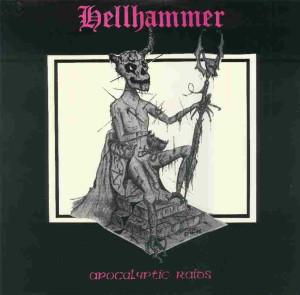
Album of the Week: Hellhammer - Apocalyptic Raids (1984)

Though perhaps obscure, Switzerland's Hellhammer is nevertheless among the most influential bands in the history of Metal. Their influence on the development of Black and Death Metal is crucial, to say the least. Yet despite their influence, Hellhammer produced precious little recorded material. Aside from a releasing a handful of demos (recently compiled and re-released as the Demon Entrails compilation) and contributing two tracks to the now-infamous Death Metal split LP, 1984's Apocalyptic Raids stands as Hellhammer's only proper studio release.

Containing only four tracks and clocking in at less than twenty minutes, Apocalyptic Raids is anything but a protracted affair. The music is pregnant with underground sensibilities--the production is mediocre at best (though easily listenable), and the musicianship has a distinctly amateurish feel. To put it another way, Apocalyptic Raids sounds like the product of four young (though talented) guys forming an impromptu band and jamming in their garage over the course of a beer-and-whiskey-fueled weekend. In fact, that's probably not too far from the album's actual recording process.

Yet it is precisely this amateurish feel that makes the album so engrossing. Apocalyptic Raids may be raw and primitive, but it is simultaneously organic--there is a soulfulness and an honesty here that I have often found wanting in more polished and better-produced popular music, even if it is "angry" and "violent".

Not long after the release of Apocalyptic Raids, the members of Hellhammer went their separate ways. Tom G. Warrior and Martin Ain formed Celtic Frost from the ashes of Hellhammer, which would be equally as influential as their previous project. Apocalyptic Raids was re-released some years later in 1990, with new artwork and two additional tracks (taken from the aforementioned Death Metal split LP). This edition, entitled Apocalyptic Raids 1990 A.D., is a bit easier to find than the 1984 original, having been reissued as recently as 1999.

22 March 2008

Album of the Week: Mayhem - De Mysteriis Dom Sathanas (1994)

Today is the 40th anniversary of the birth of Øystein Aarseth (more widely known as Euronymous). To celebrate, this week's featured album is the final album on which Euronymous worked before his rather unpleasant murder.

De Mysteriis Dom Sathanas may be the most infamous Black Metal album ever recorded. By the time of the album's release, Mayhem had become quite notorious--vocalist Dead had already committed a gruesome suicide in 1991, and Varg Vikernes (who had played bass on the album) had murdered Euronymous shortly after the band had finished recording the album. Furthermore, De Mysteriis Dom Sathanas has also been the source of much debate among connoisseurs of Metal--some consider the album to be the quintessential Black Metal album, while on the other hand iconoclasts (of whom there are many among Black Metallers) consider it highly overrated and thus think less of it. Still others argue that the album is not a product of the "true" Mayhem, as Dead and Necrobutcher (two members of the so-called Classic lineup) were not involved in recording the album. Personally, I count myself among this album's proponents.

The production values of De Mysteriis Dom Sathanas are top-notch (at least by Black Metal standars), with rawness and clarity balancing one another out quite well. To put it another way, the instruments are distorted (as is to be expected), but each one is clearly audible in the mix. Where musicianship is concerned, the band is at the top of their game.

The atmosphere of De Mysteriis Dom Sathanas is also impeccable, which are quite befitting of the lyrics (which were, by the way, composed by Dead prior to his death). The music here achieves a sense of darkness and menace that is nigh on unrivaled. Some songs are certainly better than others, but all are worth listening to. Not surprisingly, "Funeral Fog" and "Freezing Moon" are easily the best of the lot.

This isn't to say that that De Mysteriis Dom Sathanas is by any means a perfect album; it does have it's fair share of drawbacks. Some listeners are likely to find Hellhammer's habitual blastbeats a bit grating, and Atila Csihar's vocals take some getting used to--he sounds a bit like Bela Lugosi, and to be honest I really didn't like the vocals at all the first few times I listened to the album. They have since grown on me, needless to say.

De Mysteriis Dom Sathanas has an impressive reputation, but for the most part it lives up to the hype. It's influence on Black Metal is so profound as to qualify the album as a classic that is definitive of Black Metal as a genre. It is a necessary purchase for anyone who is interested in Black Metal music. Quite an achievement, considering it was the band's first full-length album.

15 March 2008

Album of the Week: Nature and Organisation - Beauty Reaps the Blood of Solitude (1994)

Nature and Organisation is the brainchild of Michael Cashmore, a long time contributor to British Neofolk outfit Current 93. As such, Nature and Organisation might sound familiar to fans of Current 93 (or Death in June, for that matter). Released in 1994, Beauty Reaps the Blood of Solitude was out of print for quite some time, but was re-released in 2007.

Beauty Reaps the Blood of Solitude features a great deal of musical diversity, from acoustic folk to neoclassical to Merzbow-esque noise. The neoclassical/folk elements by and large dominant the album, however, and the end result is one of the most beautiful albums ever recorded. It is an engaging listen from beginning to end, with the possible exception of "Beauty Destroyed," which is a cacophonous wall of distorted, electronic sound (somehow appropriate, given the track's name).

All the other tracks, on the other hand, are wonderful; picking out a single one as the best of the lot is practically impossible, though if I were pressed, I would have to nominate either "Bloodstreamruns", "Tears for an Eastern Girl" or "Bonewhiteglory".

Only recently have I begun to explore Neofolk music, and it is largely because of this album. It may be hard to find, but it is well worth the effort to procure it.

07 March 2008

Album of the week: Edguy - Theater of Salvation (1999)

Power Metal is, by definition, very silly. Few bands are quite as silly (or quite aware of how silly they truly are) as German Power Metal outfit Edguy. Of course, silly isn't always a bad thing--1999's Theater of Salvation is proof of that.

Theater of Salvation is bursting at the seams with everything that makes Power Metal enjoyable--thrashy, breakneck-speed music, laden with hooks and inspirational lyrics (and not inspirational in the Christian rock sense, either). This album--like most of Edguy's output--is a bit difficult to review in depth. To a certain extent, it does all sound more or less the same, but that can easily be overlooked, as it all sounds so rediculously good. One can choose just about any track at random, and be prepared to bang one's head along to Edguy's over-the-top greatness. The only exceptions might be the power ballads, which are a bit too hokey, even for someone like me. Standout songs include "Babylon", "Headless Game," "Falling Down" and "Arrows Fly."

I have to admit that Power Metal is something of a guilty pleasure for me--I enjoy it, certainly, but it is just so damned silly. In that respect, it's kind of like Busby Berkeley musicals. And ultimately, that's kind of what Edguy is--the Gold Diggers of '33 of Heavy Metal.

28 February 2008

Album of the Week: Eluvium - An Accidental Memory in the Case of Death (2004)

This weeks album is rather a change of pace from weeks past. Eluvium is the brainchild of Matthew Cooper, a multi-talented composer and musician. The Eluvium discography contains a variety of different sounds, from ambient post-rock to neoclassical piano suites. An Accidental Memory in the Case of Death, released in 2004, falls firmly within the latter category.

The album is a relatively brief affair, clocking in at less than a half hour, but (as the platitude goes) good things often come in small packages. The music here is extremely peaceful, with an atmosphere that seems to drift back and forth between sadness and joy. Every track on the album is solid (with the possible exception of "Nepenthe," which seems to grate on my nerves somewhat), but the odd-numbered tracks, in a peculiar coincidence, seem to be a bit better.

The first track, "An Accidental Memory," introduces the album, and reels the listener in with its stirring melody. From there the album moves on to "Genius and Thieves," which maintains the atmosphere established by the first track with its playful yet somewhat sad tune. "Perfect Neglect in a Field of Statues," one of the best pieces on the album is next, followed by "Nepenthe" which, though I don't enjoy it as much as it's predecessor or it's follower, still maintains the atmospheric flow. "In a Sense," though brief, is an effective, moving composition, indeed one of the best on the album. The longest track is next, entitled "The Well-Meaning Professor." It may also be the most dramatic song, with a more forceful melody. Finally, "An Accidental Memory in the Case of Death" brings the album to a satisfying end, reviving the melody of the introductory track and expanding it into an even more stirring theme. Indeed, this last song may be the best of the lot.

An Accidental Memory in the Case of Death is an album at once relaxing and moving. Listening to it brings to my mind the image of a room with white walls and a an exquisitely polished hardwood floor. One of the walls is dominated by a large bay window, which looks out to a cloudy sky. In the center of the room stands a piano, the source of the music, music so evocative as to be capable of conjuring up such a vivid image. It's just that good.

21 February 2008

Album of This Week: Jethro Tull - The Minstrel in the Gallery (1975)

Before I begin, I think a bit of a disclaimer is in order. I'm not nearly as steeped in the history and mythology of Classic Rock as I am in Black Metal, but I do know what I like. That being said, this week's album is Jethro Tull's The Minstrel in the Gallery.

Elements of English folk music abound on this album, not the least of which is Ian Anderson's skilled flute playing. Furthermore, these folkish passages are intertwined seamlessly with more conventional elements of traditional Rock Music. The Minstrel in the Gallery is dominated largely by two tracks, the eponymous "Minstrel in the Gallery" and "Baker St. Muse," which have the effect of bookending the album quite nicely. The latter track is quite the composition, being an amalgam of several songs into one--something which Jethro Tull did with some regualrity (see Thick as a Brick for proof), and which works quite well here, as each component song is different from the others, while being linked thematically.

A mixture of acoustic and rock tracks round out the album quite nicely; "One White Duck / 010 = Nothing At All" stands out in particular. The 2002 re-release of the album featured several bonus tracks, "Summerday Sands" being perhaps the most memorable of these (and a good song in its own right, even if it wasn't on the 1975 original.

The Minstrel in the Gallery is a Progressive Rock classic which stands up well to repeated listenings.

18 February 2008

Album of Last Week: Ulver - Kveldssanger (1995)

A vicious tag team of illness and real-world concerns (damn them!) kept me from posting much last week, so I'm going to make up for it by posting about two albums this week.

Ulver is a band that truly defies classification. They began their existence as a Folk-influenced Black Metal outfit, and later branched out into avant-garde electronica after 1998. Ulver's first three albums have retrospectively been given the title of The Trilogie. 1995's Kveldssanger was the second installment, and is the subject of my focus in this episode of Album of the Week.

What strikes the listener first is that Kveldssanger is utterly acoustic. The sound is so very different from the rest of Ulver's curriculum vitae that one might not think it was the same band. The second aspect of the album which strikes the listener is the atmosphere. The title of the album in English is "Evening Songs," and the music is well-suited to that description. The music is peaceful, with just the right balance of melancholy and contentment; inevitably, when listening to Kveldssanger I find myself envisioning summer evenings in an idyllic countryside where I have never been, yet is strangely familiar. Lyrics are sparse throughout, coming primarily in the form of two brief a cappella interludes--namely "Ord" and "Sielens Sang".

It's difficult to pick out the best tracks--every song on the album is good, and this is the sort of album which bears listening in its completion--but "Høyfjeldsbilde," "Naturmystikk," and "Halling" are my personal favorites, the first because it manages to capture that summer dusk feeling better than any other song on the album, the second because of it's incorporation of woodwinds and the third because it is perhaps the most peaceful song on the album, so much so that it feels almost happy.

Kveldssanger is one of those rare albums where I can chose a track at random and enjoy it utterly. Combine that fact with it's idyllic atmosphere, and the end result is one of my favorite albums of all time. I cannot recommend it strongly enough.

05 February 2008

Album of the Week: Kroda - Поплач менi, Рiчко... (2004)

Ukraine's Kroda is a recent discovery of mine. I heard their music for the first time in December, but it was one of those occasions where I was hooked instantly upon the first listen. The music of Kroda may best be described as Pagan Folk Metal with significant Black Metal influences, an evolution--as with so many of the Slavonic Black Metal bands in existence--of the sound pioneered by Robert "Rob Darken" Fudali of Graveland. Yet such a comparison does not truly do Kroda's music the justice it deserves.

Поплач менi, Рiчко... (in English, Cry to me, River...) may be Kroda's debut album, but it sounds more like the work of seasoned veterans. Unlike most Black Metal, the production on this album is excellent--each element of Kroda's sound is perfectly audible, including the oft-neglected Bass guitar. The drumming is precise, and avoids falling into the pattern of monotonous blast-beats which plagues Black and Death Metal. The band makes sparing use of keyboards, reserving them for only the most appropriate of moments. The most effective element of Kroda's sound, however, may well be the band's use of traditional Ukranian instruments, including the cопiлка (sopilka, a sort of flute), which gives the music an extra touch of sincerity and spirit.

Not that it needed much help, mind you--the music here is epic in the fullest sense of the word. Grand, stirring melodies accompanied by rhythms both metallic and folksy are the order of the day, and the combination works fantastically. "Where Peace and Calm were Immortalized" and "
Cry to Me, River... (Betrayal of Knjaz Volodymir)" are two of the best songs on the album, the former due to its effortless transition between fierce, full-tilt Metal and stirring Folk passages, and the latter because it represents the emotional climax of the album (appropriate, given that it is the title track!). Realistically speaking, however, there isn't a bad song to be found on this album.

Throughout, Cry to me, River... is a satisfying listen. Ukraine must be quite a place to have inspired music such as this.

28 January 2008

Album of the Week: Candlemass - Tales of Creation (1989)

Sweden's Candlemass has the distinction of being recognized as the the progenitors of Doom Metal (second only, perhaps, to Black Sabbath). Candlemass released a series of solid albums in the late 80s, beginning with the renowned Epicus Doomicus Metallicus in 1986. Each successive album was an improvement over the last, a trend which would reach its apex with 1989's Tales of Creation, which was, ironically, a re-recording and reworking of the band's eponymous 1985 demo.

Tales of Creation is something of a concept album--often a dirty word when it comes to modern music--but its themes of judgment, loss, redemption and rebirth are well suited to Doom Metal, particularly the "epic traditional" style of Candlemass. Its journey is one through sorrow and despair, yet one which ultimately concludes on a note of unexpected hope and reconciliation. Our narrator, the last of mankind, must face his destiny as the one who will decide the ultimate fate of humanity.

Here is an album which is fantastic from beginning to end--there is hardly a weak moment or a bad song to be found. Certain songs, particularly "Under the Oak" and "The Edge of Heaven", stand out as being truly excellent (I have to admit that the former ranks among my favorite songs of all time). The melodies and riffs are as heavy as any to be found in the curriculum vitae of Black Sabbath or Saint Vitus, and are also quite moving; Messiah Marcolin's signature vocal work is an excellent compliment to the music, and further enhances the album's operatic flair.

When the album reaches its conclusion, the listener is left with the same sensation one gets upon finishing a great novel or watching a masterpiece of cinema. Tales of Creation is not just great Doom Metal or even great Metal; it is great music. Without reservation, I give it the most enthusiastic of recommendations.

22 January 2008

Album of the Week: Darkthrone - Transilvanian Hunger (1994)

For the inaugural Album of the Week, I've chosen an album that has attained legendary standing in the Black Metal milieu. Though they started out as a fairly run-of-the-mill Death Metal outfit, Norway's Darkthrone quickly became of the pioneers of Norwegian Black Metal as we know it today. Unleashed upon the world in 1994, Transilvanian Hunger was Darkthrone's fourth album, and according to many Black Metalheads, their magnum opus. I wouldn't go that far myself, but I do have to acknowledge the influence Transylvanian Hunger has had on modern Black Metal.

Darkthrone's modus opperandi on Transilvanian Hunger seems to be minimalism, through and through. From the simplistic cover art (featuring a candelabra-toting Fenriz) to the infamously raw production, this album gives every impression of having been recorded in Nocturno Culto's laundry room rather than being a product of a proper recording studio. The music itself is equally understated--mid-tempo blastbeats and simple (but surprisingly effective) guitar riffs. What bass there is is barely audible.

To this day such "underground" sensibilities continues to be part of the Darkthrone ethos, and has become something of a staple of Black Metal as a whole--"cold" and "grim" production is a common trope among renowned and respected Black Metal acts, as well as up-and-coming bands seeking to establish their Black Metal street cred. When I first started getting into Black Metal two years ago, this habitual underproduction bothered me quite a bit. Yet as my taste for Black Metal has matured, I have come to relish underproduction, so long as it is tastefully done. When deliberately distorted production works, it works; and it works well on Transilvanian Hunger.

Additional nifty trivia is available from wikipedia.