 ...But this album is actually really damned good.
Showing posts with label black metal. Show all posts
Showing posts with label black metal. Show all posts
07 May 2010
15 January 2010
There's a Time and a Place for Music
I drove to work this morning in the fog. It was a kind of fog that is rare for this part of the country, a kind of fog I haven't seen since I left Washington -- an impenetrable blanket of gunmetal gray. For the first time in many months, I suddenly wanted to listen to some Black Metal.
Black Metal shouldn't make me nostalgic, but it does. As paradoxical as it may seem for me to have a pleasant emotional reaction to a form of music that is outwardly so hostile, Black Metal nevertheless reminds me of the time in my life when I was most happy. In my collegiate days I was given to bouts of brooding that I found strangely comforting (melancholy, for whatever reason, has always seemed to be my natural state). Things have not gone so well since those days were borne away by the march of time, and as the series of unfortunate events churned onward, my affinity for Black Metal became more than a little diluted (to put it another way, depressive music isn't nearly so much fun when one actually has things about which to be depressed).
As the days and months after my college graduation wore on, my joblessness became an increasingly difficult cross to bear. For consolation and comfort, I took refuge in happier forms of music, most notably Power Metal and 1930s show tunes. Perhaps not the most intellectually profound forms of music one might think of, but they nevertheless helped me muddle my way through the hard times, giving my spirits a much-needed lift and helping me believe that in one way or another, everything would work itself out in the end. Whether it has or hasn't is still up open for debate, but in any case I've taken up an interest in nihilistic, Black Sabbath-influenced Stoner Doom Metal in recent months.
It must be said, however, that my ever-evolving musical tastes are not purely based on my personal zeitgeist. Place, it seems, has had just as much of an influence. When my mania for Black Metal was at its apex, I was living in a place that was so befitting of the music that it seemed almost tailor-made for it. Black Metal is music for towering mountains and evergreen trees, for cloudy skies and impenetrable fog. These are all things that the Pacific Northwest has in spades -- it's the closest facsimile to Norway that one is likely to find outside of the genuine article.
The geography of the American Midwest, meanwhile, is hardly so captivating. The wide open plains, in all their emptiness and desolation, suggest nothing so much as a post-apocalyptic wasteland. Though not without it's occasional spurts of beauty, the Midwest is virtually devoid of any real majesty. Black Metal seems utterly misplaced here. Nor is the climate in the least bit fitting -- the Midwestern summer, with the relentless heat of the sun and the scoffing indifference of the landscape, is more suggestive of the plodding riffs of Sunn O))) or Earth than of the crisp tones of Gorgoroth or Immortal, and although the winters are bitterly cold and icy as any one might experience in Trondheim, they want for snow-capped peaks, and seem more becoming of a Mozartian funeral dirge than anything else.
The fog, though, changes everything when it rolls in. The fog obscures the dreadful openness of wide expanses and bestows a feeling of mystery and wonderment otherwise absent in this typically mundane steppe. It makes the world seem unknowable, and fills it with a sense of shadowy pulchritude. In such a penumbra I can once again feel that strangely comforting melancholy that was a keystone of the best years of my life, and that drew me to Black Metal in the first place.
Black Metal shouldn't make me nostalgic, but it does. As paradoxical as it may seem for me to have a pleasant emotional reaction to a form of music that is outwardly so hostile, Black Metal nevertheless reminds me of the time in my life when I was most happy. In my collegiate days I was given to bouts of brooding that I found strangely comforting (melancholy, for whatever reason, has always seemed to be my natural state). Things have not gone so well since those days were borne away by the march of time, and as the series of unfortunate events churned onward, my affinity for Black Metal became more than a little diluted (to put it another way, depressive music isn't nearly so much fun when one actually has things about which to be depressed).
As the days and months after my college graduation wore on, my joblessness became an increasingly difficult cross to bear. For consolation and comfort, I took refuge in happier forms of music, most notably Power Metal and 1930s show tunes. Perhaps not the most intellectually profound forms of music one might think of, but they nevertheless helped me muddle my way through the hard times, giving my spirits a much-needed lift and helping me believe that in one way or another, everything would work itself out in the end. Whether it has or hasn't is still up open for debate, but in any case I've taken up an interest in nihilistic, Black Sabbath-influenced Stoner Doom Metal in recent months.
It must be said, however, that my ever-evolving musical tastes are not purely based on my personal zeitgeist. Place, it seems, has had just as much of an influence. When my mania for Black Metal was at its apex, I was living in a place that was so befitting of the music that it seemed almost tailor-made for it. Black Metal is music for towering mountains and evergreen trees, for cloudy skies and impenetrable fog. These are all things that the Pacific Northwest has in spades -- it's the closest facsimile to Norway that one is likely to find outside of the genuine article.
The geography of the American Midwest, meanwhile, is hardly so captivating. The wide open plains, in all their emptiness and desolation, suggest nothing so much as a post-apocalyptic wasteland. Though not without it's occasional spurts of beauty, the Midwest is virtually devoid of any real majesty. Black Metal seems utterly misplaced here. Nor is the climate in the least bit fitting -- the Midwestern summer, with the relentless heat of the sun and the scoffing indifference of the landscape, is more suggestive of the plodding riffs of Sunn O))) or Earth than of the crisp tones of Gorgoroth or Immortal, and although the winters are bitterly cold and icy as any one might experience in Trondheim, they want for snow-capped peaks, and seem more becoming of a Mozartian funeral dirge than anything else.
The fog, though, changes everything when it rolls in. The fog obscures the dreadful openness of wide expanses and bestows a feeling of mystery and wonderment otherwise absent in this typically mundane steppe. It makes the world seem unknowable, and fills it with a sense of shadowy pulchritude. In such a penumbra I can once again feel that strangely comforting melancholy that was a keystone of the best years of my life, and that drew me to Black Metal in the first place.

29 November 2008
The Softer Side of Black Metal
Back in October, Hammer of Hate records released a split EP featuring two of Finland's finest--namely, Behexen and Satanic Warmaster. The album features two tracks by each of the bands, and all four are pretty solid offerings. The track that I find most intriguing, however, is Satanic Warmaster's second track, an acoustic version of his song "The Burning Eyes of the Werewolf" (which originally appeared on his debut album, 2001's Strength and Honour). As a pseudo-scholar of the Black Metal genre, I have to say that even though I haven't heard the original version (which is in all likelihood horribly under-produced), I greatly appreciate this acoustic rendition; I feel as though it supports my long-standing logic for liking Black Metal.
Even though I am as strong an advocate of the genre as you are likely to meet, I will readily admit that the Black Metal milieu---if we may call it such--is not without its fair share of foibles (and perhaps even more than that). Among these may be counted the oft-cited poor production values of the majority of Black Metal albums, the abrasive nature of the distorted guitars and the rapid-fire, merciless drumming, the often-times abhorrent ideologies espoused by many figures within the genre (which can range from petulant satanism to militant racism) and the sometimes laughable get-ups which those same figures flaunt.
Yet in spite of all this, I have long maintained that if one is willing to put aside all the peripheral baggage that comes along with the Black Metal label and is willing to simply listen to the notes that are being paid, one will find out that Black Metal is more than just sound and fury. At its most basic level, a Black Metal composition is made or broken by its melody and the ability of that melody to communicate the desired mood (which, contrary to popular belief, is not always raw, unfocused anger).
Although the title of the song might suggest a B-grade Italian horror flick from the 1960s, the acoustic rendition of "Burning Eyes of the Werewolf" nevertheless allows the uninitiated listener to get a feel for the subtleties of Black Metal songwriting. The melody--the most crucial aspect of the song as a whole--suggests several different moods. The melancholy and despair in the intro is apparent, but as the song picks up those give way to something more akin to solemn pride. Is it a masterpiece of songwriting? Hardly. But Satanic Warmaster's brief sojourn into acoustic territory nonetheless merits some interest by virtue of the fact that it allows us a glimpse of the softer side of Black Metal (or, at least, what we may understand to be the closest possible approximation to such a thing).
Even though I am as strong an advocate of the genre as you are likely to meet, I will readily admit that the Black Metal milieu---if we may call it such--is not without its fair share of foibles (and perhaps even more than that). Among these may be counted the oft-cited poor production values of the majority of Black Metal albums, the abrasive nature of the distorted guitars and the rapid-fire, merciless drumming, the often-times abhorrent ideologies espoused by many figures within the genre (which can range from petulant satanism to militant racism) and the sometimes laughable get-ups which those same figures flaunt.
Yet in spite of all this, I have long maintained that if one is willing to put aside all the peripheral baggage that comes along with the Black Metal label and is willing to simply listen to the notes that are being paid, one will find out that Black Metal is more than just sound and fury. At its most basic level, a Black Metal composition is made or broken by its melody and the ability of that melody to communicate the desired mood (which, contrary to popular belief, is not always raw, unfocused anger).
Although the title of the song might suggest a B-grade Italian horror flick from the 1960s, the acoustic rendition of "Burning Eyes of the Werewolf" nevertheless allows the uninitiated listener to get a feel for the subtleties of Black Metal songwriting. The melody--the most crucial aspect of the song as a whole--suggests several different moods. The melancholy and despair in the intro is apparent, but as the song picks up those give way to something more akin to solemn pride. Is it a masterpiece of songwriting? Hardly. But Satanic Warmaster's brief sojourn into acoustic territory nonetheless merits some interest by virtue of the fact that it allows us a glimpse of the softer side of Black Metal (or, at least, what we may understand to be the closest possible approximation to such a thing).
13 November 2008
The Art of Grimness, Ep. 9
 His dubious right-of-right-wing politics notwithstanding, Robert Fudali (alias Rob Darken) is nevertheless a pretty snazzy dresser. Truth be told, he's also a pretty good musician. Hailing from Wrocław, Poland, Rob Darken is the driving force behind the well-known Black Metal band Graveland.
Though Graveland took many cues from predecessors such as Bathory and Burzum (and who among early Black Metal bands didn't?), Rob Darken injected a certain idiomatic and epic style into his music. Whereas the majority of Scandinavian Black Metal bands concerned themselves with garden-variety Satanism, Graveland set aside the corpse paint and explored the unfamiliar territory of Slavonic Paganism instead (although with the prerequisite anti-Christian hoopla largely intact). Rob Darken's secondary project, Lord Wind, takes that theme one step further and plays a brand of Medieval folkish music.
Along with Kaldrad of Branikald over in Russia, Rob Darken of Graveland has inspired legions of Slavonic Pagan Black Metal acts across Eastern Europe, both ideologically and musically. Among their followers may be counted such notable projects as Kroda, Temnozor, Nokturnal Mortum and Drudkh.
16 October 2008

02 July 2008
Der Fünfzehnjährige Krieg der Absurd
 Few bands can boast as sordid a past as can Germany's Absurd. Absurd was formed in 1992 by Hendrik Möbus and Sebastian Schauseil, who were later joined by Andreas Kirchner. Needless to say, they were heavily influenced by the then-burgeoning Norwegian Black Metal scene. The band achieved their first bit of notoriety in 1993, when the three bandmates conspired to murder Sandro Beyer, their onetime friend. Not content simply to strangle Beyer with an extension cord, the band used a photograph of his headstone as the cover art for Thuringian Pagan Madness, their 1995 demo tape. The band continued to pursue music while incarcerated, temporarily adapting the moniker of In Ketten (meaning "in chains" in the original German).
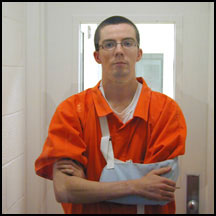 The band members were released on parole in 1998, as they were still minors when they committed the murder. Hendrik Möbus (pictured at left) soon found himself in trouble yet again, when at a concert he performed a Nazi salute, a gesture which is forbidden by German law. The result of this latest offense was the revocation of his parole. Möbus fled to the United States, for a time taking asylum with William Luther Pierce, an influential white supremacist and founder of the National Alliance. Möbus was arrested in 2000, and was extradited to Germany in 2001. At present he remains in prison. Sebastian Schauseil remains active in the German Black Metal scene (he currently serves as the guitarist and vocalist for the band Wolfsmond), though he has distanced himself from his earlier radical-right politics since leaving Absurd in 1999. Andreas Kirchner also left the band in 1999, and has since flown under the radar.
Though none of the original members are left in the band, Absurd continues to be active under the auspices of Ronald Möbus, Hendrik's brother. 2008 has seen the release of Der Fünfzehnjährige Krieg ("the fifteen year war"), which contains re-recordings of songs that were originally recorded during the Möbus/Schauseil/Kirchner days. What is one to make of music that has such a sordid history behind it? Truth be told, the music is actually pretty good, although it is pretty difficult to countenance the band's political leanings.
Musically, Der Fünfzehnjährige Krieg is something of a departure from the standard Black Metal mold (and no doubt something of a departure from the earlier sound of Absurd). Most of the tracks are of the mid-tempo variety, and do not rely heavily on blastbeats. The guitar riffs, though they demonstrate the prerequisite post-Euronymous distortion, have more of a straightforward Rock feel to them, rather than the Thrash Metal feel one normally hears from Black Metal guitarists, and possess simple--though catchy--melodies. Finally, a balance has been struck between the reptilian harsh vocals and the martial-sounding clean vocals (indeed, the latter sounds eerily like Rammstein at times).
Though I enjoy their music, I find that, in addition to be morally repugnant, Absurd's political message fits the band's name quite suitably. Aryanism and White Supremacism are, at best, laughable fallacies from which little to no good can emerge (kind of like intelligent design, but I digress). It is an unfortunate reality that some bands who write and play excellent music also espouse such atrocious ideals.
19 June 2008
Frostland Tapes
 On 23 June, Darkthrone will release Frostland Tapes, a compilation which contains all four of their demo tapes. Also included is the material which was intended for their second album, but which was set aside after Fenriz and Nocturno Culto decided to change direction and pursue a Black Metal sound (Darkthrone, as you might know, was originally formed as a Death Metal band under the name Black Death).
The Ecyclopaedia Metallum entry for Frostland Tapes has the necessary info:
To coincide with the band's 21st anniversary, this is a fascinating trip into the earliest years of the band and the first official release ever to contain all 4 of Darkthrone’s demos in one place.Collectors will no doubt leap at the chance to get a hold of this rare material, and rightly so. Darkthrone has almost never performed live in concert, which makes the included live recordings all the more intriguing. Some of the material present was previously available through the Limited Edition of Preparing for War, which was originally released in 2005. Still, there is enough new stuff here to merit obtaining Frostland Tapes, even if you are one of the lucky few to own a copy of the earlier compilation. It would have been nice if the two demos recorded during the Black Death era were included, but those have probably gone the way of London After Midnight.
Frostland Tapes also includes a rare live recording from Denmark in 1990 (one of only a handful of live appearances that Darkthrone has ever made) and, perhaps most significantly, the previously unreleased version of the infamous 1991 Goatlord rehearsal session.
These songs were intended to feature on the proposed second album, before the band changed direction and the tapes were confined to the vaults. Vocals were subsequently added in the mid-nineties, but they are presented here as the recording sounded in 1991.
08 June 2008
Album of the Week: 1349 - Hellfire

This fact was not readily apparent to me when I was a Black Metal neophyte, but though I found 1349 a bit overwhelming at first, it would eventually become one of my favorite Black Metal outfits (and the only one I have managed to see live, for that matter). One of the keys to 1349's success is that the band makes the old Black Metal formula a bit more interesting by injecting elements of technical Death Metal into their songwriting. This is especially true on Hellfire, which the band released in 2005. 1349 intersplices the ubiquitous blast beats with breakdowns and time changes, all done with crisp precision, thanks to the talented drumming of Frost (on loan-out from Satyricon, his primary project).
With Hellfire, 1349 launches a vicious, face-melting musical offensive and doesn't let up until the curtain falls. "To Rottendom" and "Sculptor of Flesh" are the strongest tracks on the album, though all the tracks have their strengths. Of interest is the title track which (not coincidentally) clocks in at thirteen minutes and forty nine seconds. By and large, Hellfire is an intense experience, but a rewarding one for the listener who is willing to tough it out.
29 May 2008
Artists of Grimness: Peter Beste

Samples from the book are available for viewing at Peter Beste's website. Though not related to Black Metal, Beste's other work is also quite good. His portrait photography captures the pathos of his subjects, at times quite poignantly. I particularly liked his Rural America series.
20 April 2008
Album of the Week: Carpathian Forest - We're Going to Hell for this (2002)
 This week's album is one which holds a special place in my heart, since it was the first Black Metal album I ever owned. More of a compilation than a proper studio album, We're Going to Hell for this was released by Norwegian outfit Carpathian Forest in 2002. It is comprised of five original studio tracks, three cover versions (including songs by Darkthrone and Venom), nine live tracks and a single demo track dating from 1996.
There are a few things about their approach to Black Metal that set Carpathian Forest apart from so many of their colleagues. First among these is the nature of their music--it is unabashed and remorseless Black Metal, but with elements of Hardcore Punk and traditional Thrash Metal which make the music of Carpathian Forest much more accessible than, say, Abruptum. Second, the production values are much better, though not excessively so (the bass guitar, contrary to genre conventions, is not only actually audible, but also fairly prominent in the mix). Finally, Carpathian Forest approaches the Black Metal aesthetic with a sense of humor--dark humor, to be sure, but humor nonetheless. It's a nice change of pace from the hyper-austerity upon which the countless Burzum wannabes and Marduk knock-offs insist so vehemently.
We're Going to Hell for This is equally valuable both to long-time fans of Carpathian Forest as well as to first-time listeners, to the former because of the quality of the live tracks and the rarity of the studio tracks, and to the latter because it serves as a good introduction to the sick and twisted (but strangely enjoyable) world of Carpathian Forest.
17 April 2008
Bondage Goat Zombie
 Belphegor's latest album saw the light of day on 11 April in Europe and on 15 April on this side of the pond. The Austrian Black/Death Metal outfit has given the title of Bondage Goat Zombie to their latest effort, which has been the subject mixed reviews. Judging by the title track, which is available for listening on the band's myspace, Helmuth and Serpenth seem to be dishing out more of the same blazing and brutal Blackened Death Metal that has been their staple (innovation is a word not likely to be found in Belphegor's vocabulary). I have yet to hear the album in it's entirety, but Belphegor's last three albums have been satisfying (if not particularly diverse), so I am hoping that Bondage Goat Zombie will continue that trend.
I just wish that Belphegor had given the album a more respectable title--they seem to have taken a page out of Dimmu Borgir's playbook, throwing three random evil-sounding words together and calling it good. But what, goes the saying, is in a name? After all, Kid Boots was a pretty good movie, despite it's goofy title.
09 April 2008
Gorgoroth to tour with Cradle of Filth; no longer Quite so Scary
Gorgoroth (the one with King and Gaahl, not the one with Infernus) recently announced plans for a European tour with Portugal's Moonspell and Greece's Spetic Flesh, beginning in December of this year. It seems like a pretty respectable line-up so far, but England's Cradle of Filth will also be a featured act on the tour. Most people with actual lives probably don't know this, but it is the sworn duty of all proponents of true Black Metal--whatever that may be--to hate Cradle of Filth with a passion. Why is this, you may ask? Largely because Cradle of Filth plays a brand of Gothic pseudo-Black Metal that is highly commercialized, and is loved the world over by overweight Goth kids who like to dress like Brandon Lee in The Crow.
Though it may seem absurd, the hatred for Cradle of Filth among devotees of Black and Death Metal is nevertheless points to one of the pillars of the Extreme Metal philosophy--namely, the dogma that any band that becomes too successful and popular are sell-outs, and therefore must be loathed for commercializing themselves.
Even if we were to set that particular tenet aside, touring with a band so MTV-friendly as Cradle of Filth is certain to damage Gorgoroth's prestige. Gaahl is one of the more enigmatic and intimidating figures in the Black Metal milieu, and not just because of his imposing stature. Does Gorgoroth's touring alongside Danny Filth and company represent an attempt to soften that image? Probably not, but Gaahl and King must have known that their decision to tour with Cradle of Filth would not go over well with many of their fans.
Then again, it has to be said that Gorgoroth is one of the best-known Black Metal acts in the world, and the upcoming tour will likely expand their audience. We may hope, furthermore, that the same tour will lead some Cradle of Filth fans to explore real Black Metal.
Elsewhere on the Gorgoroth front, Infernus continues (unsuccessfully) to try to retain legal rights the Gorgoroth name. Gaahl and King turned down a non-negotiable offer made by Infernus, and the matter is likely to go before the Norwegian courts sometime in June. I can't say I blame Infernus; he was one of the founders of the band, at it is really his brainchild.
Though it may seem absurd, the hatred for Cradle of Filth among devotees of Black and Death Metal is nevertheless points to one of the pillars of the Extreme Metal philosophy--namely, the dogma that any band that becomes too successful and popular are sell-outs, and therefore must be loathed for commercializing themselves.
Even if we were to set that particular tenet aside, touring with a band so MTV-friendly as Cradle of Filth is certain to damage Gorgoroth's prestige. Gaahl is one of the more enigmatic and intimidating figures in the Black Metal milieu, and not just because of his imposing stature. Does Gorgoroth's touring alongside Danny Filth and company represent an attempt to soften that image? Probably not, but Gaahl and King must have known that their decision to tour with Cradle of Filth would not go over well with many of their fans.
Then again, it has to be said that Gorgoroth is one of the best-known Black Metal acts in the world, and the upcoming tour will likely expand their audience. We may hope, furthermore, that the same tour will lead some Cradle of Filth fans to explore real Black Metal.
Elsewhere on the Gorgoroth front, Infernus continues (unsuccessfully) to try to retain legal rights the Gorgoroth name. Gaahl and King turned down a non-negotiable offer made by Infernus, and the matter is likely to go before the Norwegian courts sometime in June. I can't say I blame Infernus; he was one of the founders of the band, at it is really his brainchild.
22 March 2008
Album of the Week: Mayhem - De Mysteriis Dom Sathanas (1994)
 Today is the 40th anniversary of the birth of Øystein Aarseth (more widely known as Euronymous). To celebrate, this week's featured album is the final album on which Euronymous worked before his rather unpleasant murder.
De Mysteriis Dom Sathanas may be the most infamous Black Metal album ever recorded. By the time of the album's release, Mayhem had become quite notorious--vocalist Dead had already committed a gruesome suicide in 1991, and Varg Vikernes (who had played bass on the album) had murdered Euronymous shortly after the band had finished recording the album. Furthermore, De Mysteriis Dom Sathanas has also been the source of much debate among connoisseurs of Metal--some consider the album to be the quintessential Black Metal album, while on the other hand iconoclasts (of whom there are many among Black Metallers) consider it highly overrated and thus think less of it. Still others argue that the album is not a product of the "true" Mayhem, as Dead and Necrobutcher (two members of the so-called Classic lineup) were not involved in recording the album. Personally, I count myself among this album's proponents.
The production values of De Mysteriis Dom Sathanas are top-notch (at least by Black Metal standars), with rawness and clarity balancing one another out quite well. To put it another way, the instruments are distorted (as is to be expected), but each one is clearly audible in the mix. Where musicianship is concerned, the band is at the top of their game.
The atmosphere of De Mysteriis Dom Sathanas is also impeccable, which are quite befitting of the lyrics (which were, by the way, composed by Dead prior to his death). The music here achieves a sense of darkness and menace that is nigh on unrivaled. Some songs are certainly better than others, but all are worth listening to. Not surprisingly, "Funeral Fog" and "Freezing Moon" are easily the best of the lot.
This isn't to say that that De Mysteriis Dom Sathanas is by any means a perfect album; it does have it's fair share of drawbacks. Some listeners are likely to find Hellhammer's habitual blastbeats a bit grating, and Atila Csihar's vocals take some getting used to--he sounds a bit like Bela Lugosi, and to be honest I really didn't like the vocals at all the first few times I listened to the album. They have since grown on me, needless to say.
De Mysteriis Dom Sathanas has an impressive reputation, but for the most part it lives up to the hype. It's influence on Black Metal is so profound as to qualify the album as a classic that is definitive of Black Metal as a genre. It is a necessary purchase for anyone who is interested in Black Metal music. Quite an achievement, considering it was the band's first full-length album.
11 March 2008
Album Art that was Better than the Actual Music, Ep. 4
Beherit - The Oath of Black Blood (1991)
 Black Metal is a genre that prides itself on raw production. This trend began when pioneering acts like Mayhem, Burzum and Bathory cut costs on production values due to budget constraints, but underproduction has since become arguably essential to the Black Metal ethos (Dimmu Borgir and Dark Funeral notwithstanding). Yet it is possible to have too much of a good thing (good, in this case, being a highly subjective quality).
Finland's Beherit was one of the lesser-known pioneering acts in the so-called Second Wave of Black Metal, and their obscurity is plain to hear--the production on this album is godawful (though some might consider that a compliment). The mix is horribly uneven, with the vocals overwhelming the instruments, the guitars so distorted as to sound like squealing breaks on a freight train and the drums often times inaudible. I can tolerate bad production, having listened to (and enjoyed!) my fair share of bootlegged Mayhem tracks in my day, but when the music is almost as poor as the production, even I can't think of the glass as half full.
The story behind this album is more interesting than the actual product--Beherit was granted a respectable--at least by underground standards--amount of money to record The Oath of Black Blood. Rather than do anything productive, the band instead opted to spend their budget on booze and drugs. Not all that shocking; indeed, this is the sort of things that rock bands have been doing at least since the 1960s. Without anything to show for their money, the record label opted to release a compilation of some of Beherit's old demo tracks, along with tracks from the band's earlier 7" EP (entitled Dawn of Satan's Millenium). The end result was The Oath of Black Blood, which has now come to be widely renowned and loved in the Black Metal milieu.
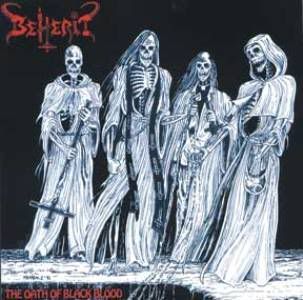
As unspectacular as the music might be, the album art is nevertheless suitably grim--it's hard to go wrong with skeletons in perverted ecclesiastical garb, after all. The artwork (as well as Beherit's logo) was done by Chris Moyen, who has provided artwork for quite a number of Black and Death Metal bands. I highly recommend you visit his website and have a look at his impressive body of work, which includes a hinger-quality version of the artwork featured above.
As for Beherit, they would thankfully improve. The Oath of Black Blood was succeeded by 1993's Drawing Down the Moon, a much better produced and much more interesting album. The band parted ways in 1996, after attempting a more ritualistic, ambient approach with their later work.
 Black Metal is a genre that prides itself on raw production. This trend began when pioneering acts like Mayhem, Burzum and Bathory cut costs on production values due to budget constraints, but underproduction has since become arguably essential to the Black Metal ethos (Dimmu Borgir and Dark Funeral notwithstanding). Yet it is possible to have too much of a good thing (good, in this case, being a highly subjective quality).
Finland's Beherit was one of the lesser-known pioneering acts in the so-called Second Wave of Black Metal, and their obscurity is plain to hear--the production on this album is godawful (though some might consider that a compliment). The mix is horribly uneven, with the vocals overwhelming the instruments, the guitars so distorted as to sound like squealing breaks on a freight train and the drums often times inaudible. I can tolerate bad production, having listened to (and enjoyed!) my fair share of bootlegged Mayhem tracks in my day, but when the music is almost as poor as the production, even I can't think of the glass as half full.
The story behind this album is more interesting than the actual product--Beherit was granted a respectable--at least by underground standards--amount of money to record The Oath of Black Blood. Rather than do anything productive, the band instead opted to spend their budget on booze and drugs. Not all that shocking; indeed, this is the sort of things that rock bands have been doing at least since the 1960s. Without anything to show for their money, the record label opted to release a compilation of some of Beherit's old demo tracks, along with tracks from the band's earlier 7" EP (entitled Dawn of Satan's Millenium). The end result was The Oath of Black Blood, which has now come to be widely renowned and loved in the Black Metal milieu.
As unspectacular as the music might be, the album art is nevertheless suitably grim--it's hard to go wrong with skeletons in perverted ecclesiastical garb, after all. The artwork (as well as Beherit's logo) was done by Chris Moyen, who has provided artwork for quite a number of Black and Death Metal bands. I highly recommend you visit his website and have a look at his impressive body of work, which includes a hinger-quality version of the artwork featured above.
As for Beherit, they would thankfully improve. The Oath of Black Blood was succeeded by 1993's Drawing Down the Moon, a much better produced and much more interesting album. The band parted ways in 1996, after attempting a more ritualistic, ambient approach with their later work.
19 February 2008
My Soul for His Glory
 Behexen released their latest album, entitled My Soul for His Glory, on 8 February (the day before my birthday, I might add). It is their first LP since 2004's By the Blessing of Satan, and it seems that their sound has undergone something of an evolution in that four year interim. The changes they seem to have made are, I assure you, for the better. Whereas By the Blessing of Satan was an onslaught of black cacophony that bordered on the unlistenable, My Soul for His Glory has a much cleaner (though still blazingly furious) sound.
Not only does the album look great (sporting excellent artwork done by Babalon Graphics), but musically it is everything that Black Metal should be. The atmosphere of blasphemous, unabashed evil is spot-on, thanks to the unexpectedly clear production that the album features. There are some great guitar riffs to be heard here--the echoing riff in "Demonic Fleshtemple" is particularly memorable. However the most pleasant surprise (insofar as this sort of raw, uncompromising Black Metal can be pleasant) lies in the rhythm section--the necessary blastbeats are present and accounted for, but they are never excessive; indeed there is a significant amount of variety in the drumming.
2008 is still young, but My Soul for His Glory is an early candidate for album of the year. Leave it to a gang of Satan-worshiping Finns to pull of a great album like this.
18 February 2008
Album of Last Week: Ulver - Kveldssanger (1995)
A vicious tag team of illness and real-world concerns (damn them!) kept me from posting much last week, so I'm going to make up for it by posting about two albums this week.
 Ulver is a band that truly defies classification. They began their existence as a Folk-influenced Black Metal outfit, and later branched out into avant-garde electronica after 1998. Ulver's first three albums have retrospectively been given the title of The Trilogie. 1995's Kveldssanger was the second installment, and is the subject of my focus in this episode of Album of the Week.
What strikes the listener first is that Kveldssanger is utterly acoustic. The sound is so very different from the rest of Ulver's curriculum vitae that one might not think it was the same band. The second aspect of the album which strikes the listener is the atmosphere. The title of the album in English is "Evening Songs," and the music is well-suited to that description. The music is peaceful, with just the right balance of melancholy and contentment; inevitably, when listening to Kveldssanger I find myself envisioning summer evenings in an idyllic countryside where I have never been, yet is strangely familiar. Lyrics are sparse throughout, coming primarily in the form of two brief a cappella interludes--namely "Ord" and "Sielens Sang".
It's difficult to pick out the best tracks--every song on the album is good, and this is the sort of album which bears listening in its completion--but "Høyfjeldsbilde," "Naturmystikk," and "Halling" are my personal favorites, the first because it manages to capture that summer dusk feeling better than any other song on the album, the second because of it's incorporation of woodwinds and the third because it is perhaps the most peaceful song on the album, so much so that it feels almost happy.
Kveldssanger is one of those rare albums where I can chose a track at random and enjoy it utterly. Combine that fact with it's idyllic atmosphere, and the end result is one of my favorite albums of all time. I cannot recommend it strongly enough.
 Ulver is a band that truly defies classification. They began their existence as a Folk-influenced Black Metal outfit, and later branched out into avant-garde electronica after 1998. Ulver's first three albums have retrospectively been given the title of The Trilogie. 1995's Kveldssanger was the second installment, and is the subject of my focus in this episode of Album of the Week.
What strikes the listener first is that Kveldssanger is utterly acoustic. The sound is so very different from the rest of Ulver's curriculum vitae that one might not think it was the same band. The second aspect of the album which strikes the listener is the atmosphere. The title of the album in English is "Evening Songs," and the music is well-suited to that description. The music is peaceful, with just the right balance of melancholy and contentment; inevitably, when listening to Kveldssanger I find myself envisioning summer evenings in an idyllic countryside where I have never been, yet is strangely familiar. Lyrics are sparse throughout, coming primarily in the form of two brief a cappella interludes--namely "Ord" and "Sielens Sang".
It's difficult to pick out the best tracks--every song on the album is good, and this is the sort of album which bears listening in its completion--but "Høyfjeldsbilde," "Naturmystikk," and "Halling" are my personal favorites, the first because it manages to capture that summer dusk feeling better than any other song on the album, the second because of it's incorporation of woodwinds and the third because it is perhaps the most peaceful song on the album, so much so that it feels almost happy.
Kveldssanger is one of those rare albums where I can chose a track at random and enjoy it utterly. Combine that fact with it's idyllic atmosphere, and the end result is one of my favorite albums of all time. I cannot recommend it strongly enough.
05 February 2008
Album of the Week: Kroda - Поплач менi, Рiчко... (2004)
 Ukraine's Kroda is a recent discovery of mine. I heard their music for the first time in December, but it was one of those occasions where I was hooked instantly upon the first listen. The music of Kroda may best be described as Pagan Folk Metal with significant Black Metal influences, an evolution--as with so many of the Slavonic Black Metal bands in existence--of the sound pioneered by Robert "Rob Darken" Fudali of Graveland. Yet such a comparison does not truly do Kroda's music the justice it deserves.
Поплач менi, Рiчко... (in English, Cry to me, River...) may be Kroda's debut album, but it sounds more like the work of seasoned veterans. Unlike most Black Metal, the production on this album is excellent--each element of Kroda's sound is perfectly audible, including the oft-neglected Bass guitar. The drumming is precise, and avoids falling into the pattern of monotonous blast-beats which plagues Black and Death Metal. The band makes sparing use of keyboards, reserving them for only the most appropriate of moments. The most effective element of Kroda's sound, however, may well be the band's use of traditional Ukranian instruments, including the cопiлка (sopilka, a sort of flute), which gives the music an extra touch of sincerity and spirit.
Not that it needed much help, mind you--the music here is epic in the fullest sense of the word. Grand, stirring melodies accompanied by rhythms both metallic and folksy are the order of the day, and the combination works fantastically. "Where Peace and Calm were Immortalized" and "Cry to Me, River... (Betrayal of Knjaz Volodymir)" are two of the best songs on the album, the former due to its effortless transition between fierce, full-tilt Metal and stirring Folk passages, and the latter because it represents the emotional climax of the album (appropriate, given that it is the title track!). Realistically speaking, however, there isn't a bad song to be found on this album.
Throughout, Cry to me, River... is a satisfying listen. Ukraine must be quite a place to have inspired music such as this.
24 January 2008
Taake Gets the Boot
 Though originally scheduled to perform at the Karmøygeddon festival in Norway on 26 April, Taake has now been compelled to bow out of the lineup, under pressure from both the festival organizers and the headlining act, the famous German thrash metal band Kreator. In all likelihood, this is probably a consequence of the band's often unruly behavior (which I'll get to in just a moment). Understandably, frontman Ulvhedin Hoest is none too pleased with this turn of events.
It goes without saying that Hoest's decision to perform a concert in Germany with a swastika painted on his chest (pictured above) was really what we in the business call a dick move, and it's also understandable that Taake was denied permission to perform at a few venues in Germany after the incident, but it seems a bit harsh to cut the band from the lineup of a festival in their homeland. Hoest has, after all, stated several times that Taake is in no way a political or Nazi band.
As for me, I wouldn't take the swastika to be indicative of the band's philosophy. The way I see things, Hoest likely only wore the hackenkreuz to stir the proverbial shit-pot. It's a real asshole thing to do, but it's to be expected. There are those people who just like to be dicks every once in a while, and our man Hoest is definitely one of them (he's done time in jail, after all). But say what you will about the man's personality, there's no denying that he's a great musician. Well, except for "Voldtekt," but that's another story.
22 January 2008
Album of the Week: Darkthrone - Transilvanian Hunger (1994)
 For the inaugural Album of the Week, I've chosen an album that has attained legendary standing in the Black Metal milieu. Though they started out as a fairly run-of-the-mill Death Metal outfit, Norway's Darkthrone quickly became of the pioneers of Norwegian Black Metal as we know it today. Unleashed upon the world in 1994, Transilvanian Hunger was Darkthrone's fourth album, and according to many Black Metalheads, their magnum opus. I wouldn't go that far myself, but I do have to acknowledge the influence Transylvanian Hunger has had on modern Black Metal.
Darkthrone's modus opperandi on Transilvanian Hunger seems to be minimalism, through and through. From the simplistic cover art (featuring a candelabra-toting Fenriz) to the infamously raw production, this album gives every impression of having been recorded in Nocturno Culto's laundry room rather than being a product of a proper recording studio. The music itself is equally understated--mid-tempo blastbeats and simple (but surprisingly effective) guitar riffs. What bass there is is barely audible.
To this day such "underground" sensibilities continues to be part of the Darkthrone ethos, and has become something of a staple of Black Metal as a whole--"cold" and "grim" production is a common trope among renowned and respected Black Metal acts, as well as up-and-coming bands seeking to establish their Black Metal street cred. When I first started getting into Black Metal two years ago, this habitual underproduction bothered me quite a bit. Yet as my taste for Black Metal has matured, I have come to relish underproduction, so long as it is tastefully done. When deliberately distorted production works, it works; and it works well on Transilvanian Hunger.
Additional nifty trivia is available from wikipedia.
21 January 2008
8 Bit Mayhem
 8 Bit Mayhem is the brainchild of some crazed Black Metal fan from the U.K. who had the idea of recording classic Black Metal songs through the soundboard of the good old Nintendo Entertainment System. The technical intricacies of NES audio are lost on me, but the results are truly a sight to see (or, rather, something to hear). One can't help but imagine what it would be like to have these tracks as the background music to Castlevania.
If you're into this sort of thing (and honestly, who isn't?), you are in luck--the band has made their debut album--cleverly entitled De Mysteriis Dom SuperNes--available for download. It bears mentioning that the above album art is actually a bit better than the artwork for the actual Mayhem's genre-defining classic.
De Mysteriis Dom SuperNes is available here:
http://www.mediafire.com/?5hw3og9zi2n
Subscribe to:
Posts (Atom)