Showing posts with label album reviews. Show all posts

08 January 2011

Pink Floyd - The Division Bell (1994)

As the years have gone by, my tastes in music have evolved and changed drastically. To give but one example, in 2007 I was very much into Black and Death Metal, whereas nowadays I am much more likely to listen to Benny Goodman or Starship Amazing than, say, Deathspell Omega. Yet amidst the ebb and flow of ever-changing musical tastes, there have been a few bands, albums and even songs that have stood the test of time. Foremost among this select few may be counted Pink Floyd, one of the most enduring bands in the history of Rock music. When pressed to name a favorite album of, most Pink Floyd enthusiasts will pick either Dark Side of the Moon or Wish You Were Here. These are certainly difficult choices to argue against -- although I am curious as to what degree these choices might be influenced by nostalgic recollections of listening to the albums on 8-track tapes whilst hot-boxing the back of a van -- but I would have to go with a more unorthodox option: 1994's The Division Bell.

This is perhaps a difficult choice to justify. Despite achieving double-platinum status in a matter of months, The Division Bell was panned by critics upon its release. Much of the bellyaching seems to revolve around the fact that The Division Bell sounds so very different from other Pink Floyd albums. This is an understandable complaint -- much of the music here seems more like experimental Space Rock than the sort of Classic Rock prevalent in Pink Floyd's earlier work (indeed, one critic dismissed it as "New Age noodling"). It should be remembered, however, that this was not the same Pink Floyd that recorded Dark Side or Wish You Were Here. Roger Waters had ended his association with the band nearly a decade earlier, and his absence is audible on The Division Bell -- put simply, the album just feels much different from its predecessors. Why, though, should that be such a bad thing? The Division Bell deserves to be judged on its own merits.

Those merits, it turns out, are considerable. With David Gilmour at the helm, the music here has a decidedly introspective and meditative character about it. Throughout the album there is a recurring theme of human communication, on various scales, whether it be a song of two humans, a cacophony of nations or a single man's alienation from the world around him. The point is perhaps made most manifest by none other than Stephen Hawking who, in one song, reminds us that "all we need to do is keep talking." Some critics have claimed that Gilmour's guitar work is somehow uninspired in comparison to his earlier work, but to perfectly honest, I just don't hear it. The musicianship on The Division Bell is no less impeccable as any of Gilmour's work before or since.

Although every track on the album is enjoyable, "High Hopes" would have to be my favorite. All at once it feels like both an overture and an encapsulation for the album as a whole. It is also the most personal song on the album, written by Gilmour from an autobiographical perspective. The song feels very epic -- not merely because it is long, but because it carries with it so much weight. More than any other song  on the album, "High Hopes" is highly evocative of images. It's difficult to explain, but give it a listen and I'm sure you'll get what I'm on about.

The Division Bell was the last studio album ever released by Pink Floyd. It may not be as critically acclaimed as earlier entries in the Pink Floyd catalog, but it is nevertheless a great album in its own right, and a worthy concluding chapter to the history of one the most influential bands of the last century.

10 July 2010

Starship Amazing - The Power of Science is Staggering (2008)


In the not-all-that-distant past I was into electronic music, primarily the more dance-oriented stuff. Although it's quite a different from what I listened to in those days, The Power of Science is Staggering by the Alaskan duo Starship Amazing is nevertheless an excellent example of just how good electronic music can be, and indeed a reminder of why I got into this style of music in the first place. 

The Power of Science is Staggering features thirteen diverse tracks, which run the gamut from laid back, hip-hop ("This is My Ideal World!" and "Kill the Body, Keep the Parts") to energetic drum and bass ("Judging By The Size of This Crater, Someone Brought the Ruckus") to more atmospheric compositions (e.g. "Finally!"). Each track is comprised of a variety of unique elements, which the result that each track is enjoyable in its own special way. Tracks such as "Finally!" and "Anyone Who is Down" feel particularly well-suited to driving around town at night, while "In a World Where Only the Strong Survive, Only the Strong Survive" seems better suited to shooting enemy robots with green laser beams while flying around in a spaceship. Then there's "Pokemon ≠ Pokemon", a song which features voice samples from Bert and Ernie from Sesame Street and is just plain fun to listen to.

If you couldn't tell by the song titles (or the name of the band, for that matter), Starship Amazing perhaps may not be taking themselves entirely seriously. Of course this only adds to the charm of the music, and when combined with the fact that Starship Amazing also seems to be quite heavily influenced by video game music makes the album that much more fun to listen to. 

In all honesty, I was quite pleasantly surprised by just how much I enjoyed this album. Whether you're a long-time fan of electronic music or just in the market for something new and exciting, you owe it to yourself to give The Power of Science is Staggering a try, and the fact that Starship Amazing has made the entire album available for free listening and download means you really have no excuse not to. Go check it out. I don't expect that you'll be disappointed by what you find.

P.S. Starship Amazing also produces a weekly podcast that is extremely entertaining. I highly recommend listening to that, as well.

23 January 2010

The Blues Preachers - Dry Long So (2009)

The Blues Preachers is a duo playing traditional American blues and folk music. This wouldn't be all that unusual, but for the fact that Brother John and Captain Bluetongue (as the players call themselves) hail from Sydney, Australia, of all places. But Australian-ness notwithstanding, the duo's take on American music sounds every bit as good the genuine article.

Released just last year, Dry Long So is The Blues Preachers' second album, featuring eighteen tracks that demonstrate a variety of sounds and styles. Songs like "Creole Belle" and "The Angel of Death" are folksy ballads, "Oh Death" and "John the Revelator" have the distinct feel of gospel dirges, "Big Road Blues" and "Hard Time Killing Floor" are excellent examples of the pure Blues sound and "Goodnight Irene" has an impeccable air of Ragtime about it (as an aside, "Oh Death" and "Hard Time Killing Floor" should sound familiar to anyone who has seen O Brother, Where art Thou?).

I like some of the songs better than others, but to tell the truth there really isn't a bad track on this album. It's a superb collection that not only gives the listener a feel for the times, but also pays tribute to styles of music that, in spite of their monumental influence, are now either only remembered primarily in small circles of particularly dedicated musicians (in the case of Blues music) or are virtually forgotten (in the case of American Folk music).

For those interested in American culture between the World Wars or just interested in music history, The Blues Preachers are definitely worth looking into. I do recommend that you give them a listen.

20 August 2008

Avantasia - The Metal Opera, Pt. II (2002)

One year after its release, Tobias Sammet and company followed the first installment of The Metal Opera with a sequel. Aptly entitled The Metal Opera, Part II, it continues and concludes the saga that began in Part I. But how does it stack up to it's antecedent? Quite well, actually. I'll put it to you this way: whereas the first episode of The Metal Opera had some fantastic standout tracks, the second episode is an overall stronger collection of songs.

"The Seven Angels", which clocks in at just under a quarter of an hour, gets the album going in grand fashion (it also recapitulates the events of the first installment). It feels and functions rather like a traditional overture, setting the stage for the forthcoming action and incorporating a variety of melodies and passages. "No Return", one of the faster and thrashier songs in the Avantasia repertoire, is next, followed by "The Looking Glass", a powerful mid-tempo rocker (as well as one of the major standout tracks). Both of these are truly solid songs, and add some nice variety to the proceedings.

Up next is "In Quest For", a largely piano-driven power ballad (it sounds like the sort of soliloquy you'd expect from a Broadway musical, in fact). It's not one of the most memorable moments on the album, but it's not bad by any means. The speed and energy return with "The Final Sacrifice", which is in a similar vein as "No Return"-very thrashy, if not quite as fast. "Neverland", another particularly strong track, is more melodic, and more anthemic. The second power ballad is next, entitled "Anywhere". As far as power ballads go, its actually pretty good--it's memorable, much more so than most of the other Avantasia power ballads.

"Chalice of Agony" is next. Aside from being one of the best songs on the album (if not in all of the Avantasia repertoire), it also feels like the musical climax of the Metal Opera saga--comparable, I would say, to the bull-fighting scene towards the end of Carmen (yes, I did just compare Heavy Metal to classical Opera, and yes, it's a perfectly valid comparison). Unfortunately, this great song is followed by two songs that just aren't quite as strong--"Memory" and "Into the Unknown", the latter seeming to function as a denouement to the whole Metal Opera.

I've been on a major Power Metal kick the past two weeks or so, the blame for which can be placed largely at the feet of the two episodes of The Metal Opera. There are plenty of great moments on these albums. It's a fairly grandiose affair, to boot--comparable to MGM musicals at their most opulent (okay, that may be a stretch, but I'll draw links between old school Hollywood and Heavy Metal any way I damn well can). Do yourself a favor and give The Metal Opera saga a listen--odds are you won't be disappointed.

Bonus youtube magic: Tobias Sammet and company playing "Sign of the Cross" live (with a bit of "The Seven Angels" thrown in just to make things interesting).

19 August 2008

Avantasia - The Metal Opera, Pt. I (2001)

The Metal Opera was the first proper effort of Tobias Sammet and his many guest musicians under the moniker of Avantasia. Whereas the supergroup's most recent effort saw Sammet and company pursuing a more mainstream rock sound, The Metal Opera--as the name suggests--is straightforward, uncompromising cavalcade of Power Metal. The album is operatic in function as well as form--it follows the story of Gabriel, a novice of the Dominican Order in 1602. Gabriel's stepsister falls into the clutches of the inquisition and is charged for witchcraft. At the same time, Gabriel is tapped by a mysterious fellow named Vandroiy to save Avantasia, a mystical dimension "beyond human imagination." Adventure ensues.

There are some truly great songs on The Metal Opera, but there are also some that are less interesting. After a short instrumental into, the album launches into "Reach out for the Light", an effective first track which serves both as exposition for the story and, with its anthemic verses and chorus, to grab the listener's attention. "Serpents in Paradise" slows down the tempo a little bit, but keeps the energy high. "Malleus Maleficarum" is the first of the instrumental interludes--it does feature some dialogue, but no actual vocals--and as such, it slows down the pace of album noticeably. The energy returns with "Breaking Away", which is similar in tempo to its predecessors, though the song itself is a bit shorter.

This brings us to "Farewell", which--in terms of the track order--is the first real standout track on The Metal Opera. It is something of a folksy power ballad, with the anthemic melodies of the latter and the time signature of a Viennese Waltz. The chorus is particularly catchy, and I often catch myself singing along to it. The next song, "Glory of Rome", is another standout track. It's the fastest most thrashy song on the album.

"In Nomine Patris" (another somewhat forgettable instrumental) is next, followed by "Avantasia". This latter is one of the two best tracks on the album. Though it is another anthemic mid-tempo rocker, the song is brimming with energy and enthusiasm--quite appropriate, given that the song is synonymous with the band. It is bookended by "A New Dimension", the third of the interludes. "Inside", another power ballad, is next, though it is unfortunately less than inspiring.

"The Sign of the Cross", however, is next, and it is perhaps the best song on the album. It is fairly traditional Heavy Metal, suggesting equal parts Judas Priest and Manowar. The chorus is no less infectious than that of "Farewell" or "Avantasia". The guitar work, courtesy of Jens Ludwig of Edguy, is also stellar. Finally, "The Tower", perhaps the most operatic (not to mention the longest) of the songs, closes out the album in suitably epic fashion.

By and Large, The Metal Opera is a solid effort, and an effective realization of Tobias Sammet's ambitious vision. The standout tracks are fantastic, and the middle-of-the-road songs are still pretty good. The only real flaw comes in the form of the interludes, which feel a little unnecessary--the album would feel no less complete without them, if not more complete. I've already mouthed my respect for Tobias Sammet as a songwriter, but it's worth reiterating that sentiment. Had he been born a century earlier, I'm fairly certain his music would be performed in Viennese opera houses.

Aside from the music, The Metal Opera is also interesting on a thematic level. One of the underlying themes on the album is the criticism of the Church for claiming to be the only medium through which one is able to reach truth and knowledge (this in addition to the usual metal themes of individual heroism). I've been listening to this album (and it's sequel, for that matter) almost every day for three months, and thus I have to give it my strongest recommendation.

02 July 2008

Der Fünfzehnjährige Krieg der Absurd

Few bands can boast as sordid a past as can Germany's Absurd. Absurd was formed in 1992 by Hendrik Möbus and Sebastian Schauseil, who were later joined by Andreas Kirchner. Needless to say, they were heavily influenced by the then-burgeoning Norwegian Black Metal scene. The band achieved their first bit of notoriety in 1993, when the three bandmates conspired to murder Sandro Beyer, their onetime friend. Not content simply to strangle Beyer with an extension cord, the band used a photograph of his headstone as the cover art for Thuringian Pagan Madness, their 1995 demo tape. The band continued to pursue music while incarcerated, temporarily adapting the moniker of In Ketten (meaning "in chains" in the original German).

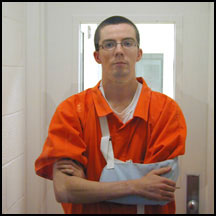
The band members were released on parole in 1998, as they were still minors when they committed the murder. Hendrik Möbus (pictured at left) soon found himself in trouble yet again, when at a concert he performed a Nazi salute, a gesture which is forbidden by German law. The result of this latest offense was the revocation of his parole. Möbus fled to the United States, for a time taking asylum with William Luther Pierce, an influential white supremacist and founder of the National Alliance. Möbus was arrested in 2000, and was extradited to Germany in 2001. At present he remains in prison. Sebastian Schauseil remains active in the German Black Metal scene (he currently serves as the guitarist and vocalist for the band Wolfsmond), though he has distanced himself from his earlier radical-right politics since leaving Absurd in 1999. Andreas Kirchner also left the band in 1999, and has since flown under the radar.

Though none of the original members are left in the band, Absurd continues to be active under the auspices of Ronald Möbus, Hendrik's brother. 2008 has seen the release of Der Fünfzehnjährige Krieg ("the fifteen year war"), which contains re-recordings of songs that were originally recorded during the Möbus/Schauseil/Kirchner days. What is one to make of music that has such a sordid history behind it? Truth be told, the music is actually pretty good, although it is pretty difficult to countenance the band's political leanings.

Musically, Der Fünfzehnjährige Krieg is something of a departure from the standard Black Metal mold (and no doubt something of a departure from the earlier sound of Absurd). Most of the tracks are of the mid-tempo variety, and do not rely heavily on blastbeats. The guitar riffs, though they demonstrate the prerequisite post-Euronymous distortion, have more of a straightforward Rock feel to them, rather than the Thrash Metal feel one normally hears from Black Metal guitarists, and possess simple--though catchy--melodies. Finally, a balance has been struck between the reptilian harsh vocals and the martial-sounding clean vocals (indeed, the latter sounds eerily like Rammstein at times).

Though I enjoy their music, I find that, in addition to be morally repugnant, Absurd's political message fits the band's name quite suitably. Aryanism and White Supremacism are, at best, laughable fallacies from which little to no good can emerge (kind of like intelligent design, but I digress). It is an unfortunate reality that some bands who write and play excellent music also espouse such atrocious ideals.

18 June 2008

The Scarecrow


Avantasia is the solo project of Tobias Sammet, the front man and principal songwriter for Edguy. Then again, it may not be quite right to call it a solo project--Tobias recruited a small army of guest musicians and vocalists to take part. 2001 saw the release of Avantasia: The Metal Opera, followed by a second installment a year later. The Avantasia saga was an ambitious work, but generally well-recieved among Power Metal enthusiasts. Six years later, Sammet has recruited yet another horde of guest musicians for another Avantasia outing. Far from being a third episode in the Avantasia saga, The Scarecrow is instead more of an all-star jam session.

Whereas I was extremely pleased with parts one and two of The Metal Opera, my feelings about The Scarecrow are somewhat mixed. What sets the latest Avantasia outing apart from its predecessors is that the new material is more along the lines of conventional Rock music than Power Metal. Most of the songs here are of the radio-friendly, mid-tempo rocker variety, and thus lack the intensity of Sammet's earlier Avantasia material. For a metalhead like me, this has the unfortunate effect of making The Scarecrow less engaging than The Metal Opera. On the other hand, there are a few truly solid songs here; "Shelter From the Rain," "Devil in the Belfry" are fast and properly Metal, and the more rock-oriented "Lost in Space" is also a quality song.

Yet there is one thing that every song does possess in abundance, and that is passion. Even if I don't always like the final product, Tobias Sammet always injects a healthy dose of enthusiasm into his music. His lyrics and music are always passionate, and I have to give him a lot of respect for that. Even if it fails to live up to its predecessors, The Scarecrow is not without its highlights. Those who are more interested in conventional Rock music might find The Scarecrow to be a satisfying listen, and hopefully it will inspire them to look into the diptych of The Metal Opera. I recommend giving The Scarecrow a listen, and enjoying it for what it is.

Bonus youtube magic:

27 March 2008

The Rule of Thirds

March 17 saw the release of The Rule of Thirds, the latest LP from England's Death in June, the brainchild of Douglas Pearce (alias Douglas P). As I continue to delve into the Neofolk genre, I have learned that Death in June is one of the pillars of the style. Along with Current 93 (a project in which Douglas Pearce is also heavily involved), Death in June was a pioneering Neofolk act, helping to define the genre in much the same way that Bathory helped to define Black Metal (and Viking Metal, for that matter, but I digress).

A bit of a disclaimer is in order: when it comes to Death in June (and Neofolk in general), I am an unmitigated neophyte. From what I have read, longtime fans of Death in June have given The Rule of Thirds a notably lukewarm reception. It's entirely possible that D.I.J. veterans know many things that I don't, but I found The Rule of Thirds to be an engaging and enjoyable listen. It's been on heavy rotation over the past several days.

Each song consists entirely of three elements--acoustic guitar, Douglas Pearce's subdued vocals and an unobtrusive blend of sampled bits of dialogue. Where some have criticized the vocals for sounding as though Pearce is bored, I find them not in the least bit so--subdued, certainly, and detached, but in a way that fits the emotional tone of the music. This brings me to the second major complaint I have happened across: as the have for his vocals, some have chided Pearce for dull and repetitive guitar techniques (too much strum, they say). Far be it from me to be a qualified judge of guitar techniques, but here too I find that the criticisms are vastly exaggerated. Pearce may not be on par with David Gilmour, but he is a perfectly good guitarist in his own right.

The Rule of Thirds is a solid album. I might become more critical of the album as I become more enlightened through exposure to Pearce's older and more esteemed releases, but I can't really see how that would be the case.

19 February 2008

My Soul for His Glory

Behexen released their latest album, entitled My Soul for His Glory, on 8 February (the day before my birthday, I might add). It is their first LP since 2004's By the Blessing of Satan, and it seems that their sound has undergone something of an evolution in that four year interim. The changes they seem to have made are, I assure you, for the better. Whereas By the Blessing of Satan was an onslaught of black cacophony that bordered on the unlistenable, My Soul for His Glory has a much cleaner (though still blazingly furious) sound.

Not only does the album look great (sporting excellent artwork done by Babalon Graphics), but musically it is everything that Black Metal should be. The atmosphere of blasphemous, unabashed evil is spot-on, thanks to the unexpectedly clear production that the album features. There are some great guitar riffs to be heard here--the echoing riff in "Demonic Fleshtemple" is particularly memorable. However the most pleasant surprise (insofar as this sort of raw, uncompromising Black Metal can be pleasant) lies in the rhythm section--the necessary blastbeats are present and accounted for, but they are never excessive; indeed there is a significant amount of variety in the drumming.

2008 is still young, but My Soul for His Glory is an early candidate for album of the year. Leave it to a gang of Satan-worshiping Finns to pull of a great album like this.

13 November 2007

Shadows of The Sun


Few bands are less predictable than Ulver. Their music has ranged from the primal Black Metal of Nattens Madrigal to the idyllic Folk of Kveldssanger to the dissonant electronic experimentation of Blood Inside. Ulver continues their time-honored tradition of breaking with tradition with their latest release, Shadows of the Sun.

This time around, Garm and company have presented us with a quiet, melancholic and down-tempo opus; it sounds like nothing so much as a darkened evolution of Sigur Ros. This, I assure you is a good thing. While it may be nigh on impossible to discern individual notes within these songs, the emotional punch that Ulver's array of ambient sound packs is nonetheless potent--indeed, it is in that sense comparable to Kveldssanger, though Shadows of the Sun is entirely electronic.

Each soung on the album seems to flow into the next ("All the Love", for example, transitions seamlessly into "Like Music"). Each contributes to the album's atmosphere of gloom and sadness while at the same time maintaining its own unique aura. "Eos," "Vigil" and "Solitude" (a cover of Black Sabbath's homonymous song from 1971's Master of Reality) are among the standout tracks, the latter being a particularly poignant variation on the original version.

Though it will surely appeal to fans of Ulver's later material more than those who favor the band's earlier work, Shadows of the Sun is an excellent album, and well worth repeated listenings.