Showing posts with label essays. Show all posts

03 June 2010

The Wrestler and The Champ

Memorial Day is customarily a day for war movies, more often than not featuring Audie Murphy or (less enjoyably) John Wayne. I opted to break with tradition, however, and watched The Wrestler.

Here is a movie with a lot to like about it. First and foremost is the great performance by Mickey Rourke. In a picture that is by and large a character study, Mickey Rourke really brings the downtrodden Randy "The Ram" Robinson to life (apparently, he improvised significantly in several scenes, adding to the naturalistic feel of his performance). Secondly, the mise-en-scene is truly fantastic -- in addition to the gritty camera work, the film's setting in central New Jersey really enhances the feeling of decrepitude that is prevalent throughout the film, particularly the scenes on the ruined boardwalk in Asbury Park (indeed, much of the filming was done in and around Elizabeth, not far from my old hometown of Passaic). Then there's the surprisingly appropriate soundtrack composed largely of 1980s Glam and Heavy Metal tracks, alongside similarly styled original compositions (performed by former Guns 'n' Roses guitarist Slash). Finally, the film also provides a fascinating behind-the-scenes look at the world of independent wrestling promotions (full disclosure: I was big wrestling fan in the mid '90s. Of course, I still thought it was real back then).
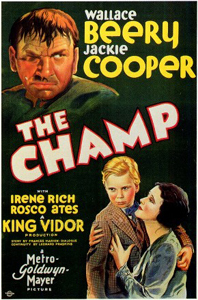
To put the matter simply, The Wrestler is truly a very good movie. I couldn't help but notice, however, a few striking similarities between this movie and King Vidor's 1931 film The Champ. To begin with, the protagonists of the two pictures are very much alike -- Mickey Rourke's and Wallace Beery's respective characters are both former champs long past their prime, living in destitution and just managing to eke out a living by fighting in obscure matches. Even their names are similar -- compare Mickey's Randy Robinson to Wally's Andy Purcell. Perhaps the most significant similarity, however, is the fact that both Randy and Andy suffer from dangerous heart conditions.

One significant point of departure, on the other hand, is the protagonists' relationships with their children. In The Champ, Andy Purcell's relationship with his son Dink (played by Jackie Cooper), although quite strained at times, is nevertheless a loving one. Although he drinks heavily and gambles uncontrollably, Andy still cares a great deal for his son, and Dink looks up to him in spite of his flaws. Although Randy Robinson cares for his daughter Stephanie and regrets not having been a better father to her, it's nevertheless clear that, despite Randy's best intentions, their relationship is largely damaged beyond repair.

Yet the most compelling point of comparison between the two movies might be -- perhaps naturally -- their endings (spoilers ahead, by the way). In a final gamble to turn their lives around, Randy and Andy enter into climactic matches. Although they both emerge victorious, in both cases the victories come (or at least seem to come) at too great a cost. Andy manages to rally from a brutal beating to knock out his opponent, but suffers a fatal heart attack in the wake of the match (as an aside, Jackie Cooper is great in these final few scenes -- his tearful performance doesn't just tug at your heart's strings, it tears the whole thing out of your chest and throws it down at your feet). Meanwhile, Randy is on the way to winning his match when he begins to suffer from heart attack-like symptoms. With his opponent on the mat, Randy pulls himself up to the top turnbuckle for one last leap (this after delivering a heartfelt oration prior to the match, in which he tells the audience that they are his true family). One does not know beyond a doubt that Randy dies after his leap, but it isn't hard to imagine that he does.

Both Andy Purcell and Randy Robinson go out in a last blaze of glory. In doing so, they redeem themselves in the eyes of those dearest to them -- Andy proves his worth to both his son and his estranged wife by sacrificing his life to ensure that Dink has enough money to live on, and Randy manages, even if only for a little while, to once again win the hearts and minds of his own "family."

Of course, this isn't to say that The Wrestler is a rewrite of The Champ; In fact, I'd be surprised if The Champ actually was the first movie to tell this sort of story. The story of a broken man who, even if only a small way, manages to set things right is a theme with a timeless appeal, and one at the very heart of both movies. Although the films are poles apart in terms of feel and technique, it's their common theme that makes The Wrestler and The Champ such excellent movies. Do yourself a favor and watch them both.

15 March 2010

Detritus, Michigan

I find Detroit somehow alluring. It's a strange thing to say about a city in such hopeless disrepair, a city that is the butt of so many jokes about urban decay, a city that has become symbolic of dysfunction and disrepair. Yet in spite of all the harsh realities of Detroit, I cannot help but be drawn to it. So much of what wrong with Detroit -- its broken down buildings, its urban prairie -- seems strangely familiar to me. I cannot help but see in that careworn city a reflection of myself.

In the first half the last century, Detroit must have seemed symbolic of all that was right with America -- between 1900 and 1930, Detroit proliferated from a city of a quarter-million people to a metropolis of one and a half million, thanks in no small part to its remarkable industrial boom. It was once known as the "Paris of the West" for its magnificent architecture, and during World War II Detroit's industrial might garnered it the honorific moniker of the Arsenal of Democracy. By mid-century, Detroit stood as the nation's fourth largest city, and certainly one of its most important.

Yet Detroit was never perfect -- even in its glory days the city was beset by organized crime and racial tensions. The latter, in particular, was a recurring problem that would prove a crucial factor in the city's downfall. Race riots -- the most notorious of which must be the Twelfth Street Riot -- were just as destructive to the fiber of Detroit as were the decline of the auto industry and the proliferation of drugs in the 1970s. Between 1950 and 2000, worsening social and economic conditions caused the city's population to plummet from more than 1.8 million to just over 900,000. If the first half of the century saw Detroit's meteoric rise, the second half of the century was witness to its calamitous decline.

The woeful dilapidation in which the city now languishes is well documented -- its myriad abandoned and decaying structures have been the subjects of numerous photographic surveys, and its continuous struggles are frequently fodder for journalistic investigation (Time magazine, in fact, has devoted a blog to chronicle a year in the life of Detroit). Even Detroit's sports teams seem to be afflicted by the malady -- despite the Tigers' surprising run to the World Series in 2006, only two years later the Lions secured their ignoble spot in the record books by losing every game they played that season. Detroit's future, it seems, is none too bright.

The obituary, however, has not yet been written. In spite of pandemic unemployment, in spite of bargain-basement property values and in spite of the fact that most of the rest of the country seems perfectly willing to leave its eleventh largest city for dead, Detroit still lives. It may be a life of blood, tears, toil and sweat for its citizens, but nevertheless the city still lives, and it strives to rise from its ashes. In this gritty and grinding perseverance, Detroit still represents, in a peculiar yet strangely profound way, what is right with America.

I cannot help but admire the spirit of Detroit, and to hope and cheer for its renaissance. After all, if an entire city can revivify itself, there is reason to believe that I, having fallen from my own glory days, can achieve a similar recovery. How insignificant my troubles must seem when juxtaposed with the troubles of 900,000 citizens! Nevertheless, they are my troubles. Yet if I could face whatever troubles I have with the same grim determination as the city of Detroit, perhaps I might be able to hope that there are better days ahead for me, as well.

Of course, let's have no delusions -- for Detroit, the road to recovery will be a long and arduous one, indeed. In many ways, the city will need not only to simply revitalize itself, but to reinvent itself. Yet if Detroit has made it this far without collapsing, there is ample reason to believe that it can make it the rest of the way. I'll certainly be rooting for it -- after all, a reborn Detroit would be an heroic achievement, and a beacon of hope to all those of us who have fallen upon our own hard times.

[Image Sauce]

15 January 2010

There's a Time and a Place for Music

I drove to work this morning in the fog. It was a kind of fog that is rare for this part of the country, a kind of fog I haven't seen since I left Washington -- an impenetrable blanket of gunmetal gray. For the first time in many months, I suddenly wanted to listen to some Black Metal.

Black Metal shouldn't make me nostalgic, but it does. As paradoxical as it may seem for me to have a pleasant emotional reaction to a form of music that is outwardly so hostile, Black Metal nevertheless reminds me of the time in my life when I was most happy. In my collegiate days I was given to bouts of brooding that I found strangely comforting (melancholy, for whatever reason, has always seemed to be my natural state). Things have not gone so well since those days were borne away by the march of time, and as the series of unfortunate events churned onward, my affinity for Black Metal became more than a little diluted (to put it another way, depressive music isn't nearly so much fun when one actually has things about which to be depressed).

As the days and months after my college graduation wore on, my joblessness became an increasingly difficult cross to bear. For consolation and comfort, I took refuge in happier forms of music, most notably Power Metal and 1930s show tunes. Perhaps not the most intellectually profound forms of music one might think of, but they nevertheless helped me muddle my way through the hard times, giving my spirits a much-needed lift and helping me believe that in one way or another, everything would work itself out in the end. Whether it has or hasn't is still up open for debate, but in any case I've taken up an interest in nihilistic, Black Sabbath-influenced Stoner Doom Metal in recent months.

It must be said, however, that my ever-evolving musical tastes are not purely based on my personal zeitgeist. Place, it seems, has had just as much of an influence. When my mania for Black Metal was at its apex, I was living in a place that was so befitting of the music that it seemed almost tailor-made for it. Black Metal is music for towering mountains and evergreen trees, for cloudy skies and impenetrable fog. These are all things that the Pacific Northwest has in spades -- it's the closest facsimile to Norway that one is likely to find outside of the genuine article.

The geography of the American Midwest, meanwhile, is hardly so captivating. The wide open plains, in all their emptiness and desolation, suggest nothing so much as a post-apocalyptic wasteland. Though not without it's occasional spurts of beauty, the Midwest is virtually devoid of any real majesty. Black Metal seems utterly misplaced here. Nor is the climate in the least bit fitting -- the Midwestern summer, with the relentless heat of the sun and the scoffing indifference of the landscape, is more suggestive of the plodding riffs of Sunn O))) or Earth than of the crisp tones of Gorgoroth or Immortal, and although the winters are bitterly cold and icy as any one might experience in Trondheim, they want for snow-capped peaks, and seem more becoming of a Mozartian funeral dirge than anything else.

The fog, though, changes everything when it rolls in. The fog obscures the dreadful openness of wide expanses and bestows a feeling of mystery and wonderment otherwise absent in this typically mundane steppe. It makes the world seem unknowable, and fills it with a sense of shadowy pulchritude. In such a penumbra I can once again feel that strangely comforting melancholy that was a keystone of the best years of my life, and that drew me to Black Metal in the first place.

21 November 2009

Ten Years On

There's a fairly interesting article in the New York Times about the rapidly-approaching end of the decade and how this decade will be remembered. One perspective that isn't represented in the article, however, is that of one who came of age in the 2000s. These last ten years were an interesting time to be alive, fraught with political intrigue, full of social upheaval. I expect that years from now the 2000s will be remembered in much the same way that the 1960s are remembered--if there's a television show about life in the 2000s, it's going to be a lot more like The Wonder Years than That 70s Show.

While the 1990s were a time of optimism and prosperity, the 2000s were a time of strife and unease. The decade began with the scandalous presidential election of 2000 which delivered George W. Bush into the White House (for better or worse). Maybe there was a bit of flotsam and jetsam in the corridors of power, but that much, I figured, was to be expected. After all, anyone raised in a post-Watergate America was brought up in the common knowledge that all politicians are liars and cheaters. Perhaps it didn't matter who was pulling the strings--one politician was the same as any other (or so I thought, anyway).

Then, not even a year later, that day came. On that day, the decade began in earnest. Everyone will remember where they were and what they were doing when the world changed on the morning of September 11, 2001. The nation went to war that day, fueled by outrage and a berserk lust for revenge. Two years later, the United States invaded Iraq. Why? Nobody really seems to know why, even all these years later. Maybe we got tired of Afghanistan and decided to try something different. Whatever the reason we decided to start the war, it certainly doesn't seem to have made things any better for us. As we waged wars overseas, our economy began to fall into a shambles, until the whole thing very nearly collapsed in 2008.

This was the world in which I came of age. In the last ten years, I have seen that the omnipotence, invulnerability and moral infallibility of my country--convictions which, when the decade began, I held very dear--were simply illusions. That is how I will remember the 2000s: a decade of disillusionment.

16 November 2009

My Own Personal Purgatory

Ever since I first read the Divine Comedy, I have sought to adopt Dante Alighieri as something of a mentor (although I wouldn't presume that I have one tenth the talent he had). I strove to model my life after his in as many ways as I could, drawing parallels wherever I might find them. Three such parallels are of paramount importance: the life-changing unrequited love, the exile from the home city and the loss of the proper path. My circumstances may not have been as drastic as Dante's, but these parallel incidents had no less of an impact on my life than they did on Dante's life.

As Dante had his Beatrice, I had my own lost love. More accurately, I had a series of lost loves, totaling a half-dozen over the course of the past seven years. Dante's loss was perhaps more catastrophic than mine--he lost Beatrice through her own premature death, whereas my losses came about through my own bungling, my own inaction or the simple impossibility of my beloved loving me in return. But however the specifics of our respective heartbreaks might differ, the effect of heartbreak upon Dante and me was much the same. In our spiritual and emotional anguish, Dante and I took solace in introspection. Ultimately we both concluded--Dante, naturally, in an exponentially more masterful fashion than I--that love, even if it be unrequited, was the true path to salvation.

For Dante, salvation had a primarily religious meaning; that is, through his love for Beatrice he was able to overcome error and sin and once again walk the path to God. For me, on the other hand, salvation was more introspective and philosophical than it was literal. It was not from hellfire and damnation that I needed to be saved, but rather from the wicked, base and ultimately self-destructive elements of my own character. Even if my beloved did not reciprocate my affections, the sensation of simply being in love compelled me to better myself, both physically and spiritually. Because I was in love, I could shun the perverse, slothful and avaricious temptations of the world around me and instead focus on the noble and beautiful aspects of life.

The wounds of lost love were deep, to be sure, and they certainly left their scars; nevertheless, they did heal. The old wounds would be compounded by new ones, however, as both Dante and I found ourselves cast out from the cities we called our homes. The specifics again differ--Dante was exiled from Florence for political reasons, and I was compelled to leave Seattle by my financial difficulties. Nonetheless I too was forced to abandon the things I loved, and I too would come to know the bitter taste of others' bread, and how difficult the the path is for one who must ascend and descend others' stairs.

Dorothy Gale was right--there is no place like home. But Kansas City is not my home, no more than Ravenna was Dante's home or Tomis was Ovid's home. For me, Kansas--to say nothing of Missouri--is a vast wasteland, a sprawling prison cell from which I cannot seem to break free. Even more disheartening is the fact that my exile is also a return to a past from which I wanted to badly to escape. In my exile I find that I have lost my way, and am wandering directionless through the dark wood of error.

Owing to scale, depth and sheer audacity of the work, I consider Dante's Divine Comedy the single greatest work in all of western literature (although I am certain that legions of scholars and other literati will disagree with me quite vehemently). Less controversial (but perhaps more important) is the fact that the Divine Comedy has influenced me so profoundly that I at times consciously attempt to model my own life's journey after Dante's pilgrimage. After all, if one considers the pervasive theme of the Divine Comedy--namely, that love is the true means of salvation and redemption--one must conclude that it is a better guide to life than any religious text could pretend to be. That aspect of Dante's philosophy I have incorporated into my own.

09 July 2009

The Curious Case of the Russian Liberation Army

One of the more obscure oddities of the Second World War--at least by the standards of western historiography--is that of the Russian Liberation Army (Русская Освободительная Армия). Comprised largely of Russian anticommunists and Red Army prisoners of war, the ROA was equipped by and organized under the auspices of the Wehrmacht. At the head of the ROA was General Andrei Andreyevich Vlasov, who had denounced Communism and defected to the Germans after his capture in 1942 (Vlasov had previously served with some distinction in the Red Army, in particular during the Battle of Moscow). Despite having been ostensibly formed to fight the Red Army and free Russia from the Bolsheviks (to say nothing of Stalin himself), the ROA was in actuality either deployed to the western front or relegated to rear-echelon duties, and did not see action against the Soviet army until 1945, when any realistic chances of German victory were long gone.

Not surprisingly, Soviet historiography considers Vlasov and his followers to be traitors. This is quite an easy interpretation to justify--the ROA sided with the invading Germans and eventually fought against their own countrymen. One might expect that sentiment to have carried on to the present day, and for the most part it has. On the other hand, there are those who hail Vlasov and the ROA as Russian heroes. Such an interpretation is not without its basis--the ROA did turn against the Germans in May of 1945, fighting alongside Czech insurgents against units of the SS.

However, the heroization of the ROA tends to ignore the true nature of the German invasion of the Soviet Union. Quite common among the messages of German propaganda during the war was the idea that the Nazis were crusading to free Europe from the specter of Bolshevik domination (to say nothing of the Jews). Indeed, it was for this very reason that many joined the ROA (it's probable that many of those who enlisted in the Waffen SS did so for the same reason). The struggle against Communism might have been an accessory motivating factor behind Operation Barbarossa, but the ultimate goal of the German invasion of Russia was not to liberate the peoples of Eastern Europe, but to liquidate them: as outlined in Hitler's Generalplan Ost, some 50 million people were to be killed in order to achieve the necessary lebensraum for the German people, a number that makes the millions who did die in the Holocaust seem almost paltry by comparison.

Where, then, does this leave the men of the ROA? Although its probable that many of their number were simply Nazi sympathizers, it seems perfectly absurd to think that they would advocate the genocide of their own people. Rather, the men of the ROA likely enlisted because--thanks in no small part to Nazi propaganda--they believed they were doing the right thing for Russia. The notion of a Russia free from Bolshevism must have been appealing, indeed; after all, untold millions died as a result of the Holodomor and Stalin's purges during the 1930s, and the curtailment of personal liberties under the Soviet government throughout its existence is well documented. Furthermore, if there is any sincerity behind the Prague Manifesto, the the cause of the ROA would seem quite just, indeed. Finally, its highly unlikely that either Vlasov or the men of the ROA were in any way privy to the details of Generalplan Ost--odds are that they would have been killed in the wake of German victory, along with the rest of the Russian people. Perhaps the devil you know is preferable to the devil you don't, after all.

What, then, is posterity to make of the Russian Liberation Army? Were they heroes, or were they traitors? Given the respective evils of Nazism and Bolshevism, it really is hard to say--choosing one over the other is like choosing whether to die of cancer or of lupus. Ultimately, they may be neither villains nor victims; perhaps, like the tens of millions of others, they were statistics--mere pawns in the calamitous waste of human life that was the Second World War.

22 October 2008

"Oh Lord, this must be Heaven..."

My first conception of Heaven was a graveyard. When I was a child, I lived in the vicinity of several cemeteries, one of which was right next door to the playground where my classmates and I used to go for recess. All that separated the basketball court and the swing set from row after row of marble headstones was a chain-link fence that the more athletic among us would occasionally climb over to retrieve the odd lost basketball. My understanding of death and eschatology was considerably limited, but I figured out fairly early on that the cemetery was where the dead inevitably wound up. In retrospect, that curious arrangement seems a poignant reminder of the thin line that separates life here on Earth from the great beyond.

One of the earliest of my dreams that I can recall with any notable clarity was a dream wherein my parents decided that they wanted to be rid of me. Having been turned out of my home, I wandered outside. A great light now came from the sky, and as I looked up I saw the blue sky part like satin curtains, revealing an idyllic cemetery, the kind one might expect to find in a churchyard on an island off the coast of Britain. What I remember most of my vision-within-a-vision was a monolithic black headstone, in the shape of a cross. For all I knew, it might well have been my own headstone. As I beheld this sight, slack-jawed in wonder, I was overcome by a great sense of longing and, more poignantly, a desire to be there, in that cemetery.

Ever since I had that dream so many years ago, cemeteries have held a profound appeal for me. Whenever I pass one, I always feel an inexplicable desire to go inside and to wander among the headstones, reading the names inscribed upon them and wondering who these departed souls were. One of the more interesting twists of fate in my life is that my first lessons in driving took place in a cemetery.

My conception of Heaven (and indeed of the afterlife in general) has changed greatly over the years. I tend not to think of the afterlife so much as a material place as a state of mind. I think of death and the afterlife as an eternal sleep. If the soul is at peace, its dreams will be peaceful. Heaven, then, is a kingdom of sweet dreams--serene images either remembered from one's life experience or imagined. The comparison of sleep and death is as old as human life itself. Indeed, the connection is present in the very word cemetery, which derives from the Greek κοιμητήριον, meaning "sleeping place."

The only thing I want from life is for my soul to be at peace when I die. I can forgo all the material symbols of success and good life, so long as I can be die a truly peaceful death, and take my place in the cemetery to sleep the eternal sleep and dream eternal dreams.

10 May 2008

Out Of The (Animated) Past

I recently had an epiphany of sorts. I have been wondering as of late why I am so fascinated with Art Deco. Though I am three quarters of a century removed from the heyday of the Jazz Age, it has nevertheless always felt very familiar to me. I was watching a few cartoons on YouTube which I remember watching in the bygone days of my childhood. After a quick bit of research, I realized that a good number of these dated from the mid-to-late-1930s.

Like most American children--and a good many European children, I imagine--I grew up with the Warner Bros. pantheon of cartoon characters. Most of these, including Bugs Bunny, Daffy Duck and Porky Pig, came into existence in the late 1930s, but did not take on their iconic forms until the 1940s and 1950s. As much as I liked the cartoons featuring those famous figures, it was always the older ones from which they were absent that captured my imagination. They always seemed so ancient--watching these cartoons was like looking into another world. And in many ways, it was. The Jazz Age was swept out of the popular subconscious by World War II, and was further buried by the newfound prosperity and technological progressiveness of the Atomic Age.

The Second World War was such a momentous event in the American mythos that we have become accustomed to thinking of the entire spectrum of Western history as part of two eras--before and after Pearl Harbor. In my younger years, I thought that way myself. Antiquity, the Middle Ages, the Enlightenment and the Jazz Age all fell into that largely homogenized morass of the before; American popular culture had become (and continues to be) so far removed from anything before December 7, 1941 that Cicero and Horace might as well be contemporaries of Abraham Lincoln and Douglas Fairbanks.

That is why I, as a young American, found those old cartoons so fascinating. It was a way of looking into that forgotten world, a way more real in my child's eyes than any history book I could have read.

04 February 2008

Some Thoughts on Race

What follows is an essay that I recently wrote for one of my classes (entitled Classics 305: Inventing the Barbarian). I decided I would post it here, as it might make for some interesting reading.

Prior to giving serious study to the subject, my thinking process and attitudes on race were shaped largely by my experiences the social climate in which I spent my formative years. When I was knee-high to the proverbial grasshopper back in northern New Jersey, my family was one a few gentile families in a predominantly Orthodox Jewish neighborhood. My next door neighbor and best friend for years was a girl with a white mother and a black father. A diverse selection of races was present in my kindergarten and First grade classes. People were aware of the differences, but by and large they accepted one another. This is not to say that I lived in some sort of egalitarian utopia; there was some discrimination, as there will be in any human society, and there were times when I myself was on the receiving end of it (which, I suppose, is to be expected when one is part of the minority). Bearing in mind my experiences of being one of the others made me somewhat doubtful of Snowden’s description of an egalitarian classical oecumene, as appealing as his portrait was. When I moved to Kansas City I was quite aware of the difference in the cultural climate, even at my relatively young age. This was the first time I ever really gave serious thought to the issue of race.

For many years thereafter, my way of defining race was in lock-step with the cultural norm—race, I thought, was a matter of physical traits and cultural practices (the latter including language). On the other hand, the more I read about history and the movements and intermingling of nations, tribes and ethnoi, the more that definition becomes ambiguous. Some of what I have read has questioned whether or not race was a scientific fact, or a concept created by humans. As we have seen in Jared Diamond’s article, people can be classified and race can be ascribed in a variety of ways, depending on what criteria one wants to use. For my part, I still believe that race is a fact; that Zulus and Scotsmen are different from each other in several noticeable ways is quite obvious. On the other hand, I don’t think that race is the be-all-end-all of anthropology. To put it another way, I find that race is like gravity—it exists, and it is important, but actually defining race is something of a Sisyphean task.

None of the various criteria that I have seen used have been able to encompass all aspects of race. Physical characteristics—perhaps thanks to miscegenation of different ethnic groups over time—do not define race completely. For example, we tend to think of both Taurinese and Sicilians as being Italian, but the former group tends to have noticeably lighter skin than their southern cousins. I still believe, however, that physiognomy is an important element of race. Neither is language a satisfactory barometer for determining race—the dialect of Italian spoken by a native of Turin is not at all what a native of Syracuse would speak, to return to my earlier example. For an even starker contrast, one may consider that Haitians and Quebecois both speak French dialects, though it is plain to see that they are not the same race.

I think that much of the difficulty in defining race can be ascribed to the historical tendency of various peoples to come into contact and intermingle with one another (with sometimes violent results, as has been the case throughout history). The very reason that black Hatians in the Caribbean speak roughly the same language as white Parisians is a direct result of French colonialism, of which the abominable (at least by modern standards) practice of slavery was an integral part. Similarly, the gradient of physical attributes visible among the various peoples of Europe (or indeed most other places in the world) owes much to the fact that myriad tribes have invaded and fought over land and resources for untold centuries. Of course, this is all just a theory for which I have no solid evidence. Nor do I have an explanation for why the different tribes should have been so different in the first place—evolutionary response is a tempting scapegoat, but here too there is a troubling paucity of evidence.

Much of our difficulty in understanding race, I believe, arises from social and cultural obstacles. Primary among these is the phenomenon political correctness. It has been my suspicion for some time that we as a society tend to dance around the issue of race, typically for fear of offending someone or sounding racist or otherwise discriminatory, and thus many of the conflicts regarding race often go unresolved. On the other end of the spectrum, our xenophobic tendencies can lead to violence when left unchecked—consider, for example, the 1967 race riots in Newark and the 1992 riots in Los Angeles, or the immigration controversies in the United States and the United Kingdom which continue to this day. In this day and age, where ethnic and cultural diversity is considered a point of pride, the crux of the problem may be that we either do not acknowledge that race is an issue or are unable to deal with racial tensions in a nonviolent manner. Not that I mean to belittle diversity—it does a species well to introduce new genes into the collective gene pool; dogs of mixed breeding, for example, are often more intelligent than their thoroughbred counterparts.

So where does this leave me? I still believe that race is a naturally-occurring phenomenon, and that it is a matter of no small importance. Defining race, on the other hand, is a troubling matter. Yet if we are to come up with a satisfactory definition of race, we perhaps ought to reconsider out attitudes concerning the subject in the first place.