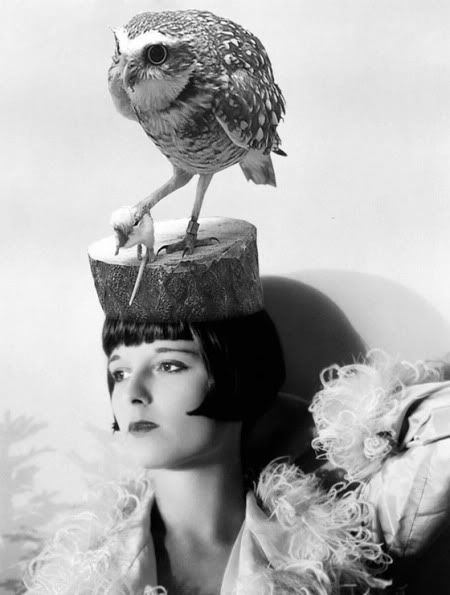
Pandora's Box -- or, if you prefer, Die Büchse des Pandoras -- tells the tale of Lulu, a woman with a dubious past and an irresistible sex appeal. The latter is a potent means by which she procures whatever it is her heart may desire, leaving in her wake a string of ruined men and discarded lovers. She is the archetypal "bad woman" about whom mothers warn their sons. Lulu's escapades take her from the stage of a Weimar cabaret to a dockside gambling house and finally to the slums of London, where she meets an inglorious end at the hands of a serial killer very much reminiscent of Jack the Ripper.
Lulu's story is told in a series of chronological acts that illustrate episodes in Lulu's torrid life (this narrative structure has the added bonus of keeping the story moving at a healthy pace; rarely, if ever, does the film feel as though it's dragging on). Lulu's only constant companions throughout her travails are a crusty old drunkard named Schigolch and Alwa, a young man who is hopelessly in love with Lulu. Schigolch is a particularly interesting character who would hardly be out of place in a novel by Charles Bukowski. Lulu describes him as her "first patron," which leads us to believe that he may be some sort of pimp. Later, however, our understanding of their relationship is muddied significantly when Lulu, in an attempt to save him from one of her lovers, claims him to be her father. This may not necessarily be true, but it is a tempting possibility, as there are a few instances in the film where Schigolch does seem to display some genuine paternal affection for Lulu. Furthermore, Schigolch is the only major character in the film whom Lulu does not screw over (or, just plain screw, for that matter). It's difficult to fathom a father who has no objection to his daughter sleeping around and eventually prostituting herself, but this is just the sort of moral ambiguity of which this film is quite fond of presenting to its audience.
Alwa, meanwhile, is quite possible the most pitiable and sympathetic character in the film. Even though it is painfully obvious that he is little more to Lulu than a boy toy with a well-stuffed wallet, Alwa is much to smitten with Lulu to bring himself to leave her. One can almost feel his soul being pounded into dust as he watches Lulu flirt and philander with other men (and women, as the case might be). The hopelessness of his emasculating circumstances are hardly lost on Alwa -- having fallen with Lulu into the gutters of the London slums, he laments to a curious Salvation Army worker that nobody can help him.
As complicated as are Lulu's relationships with her companions, her relationship with the audience is no less conflicted. Lulu is unrepentantly wicked and undeniably ruthless, yet in spite of that she is also somehow sympathetic. Reviving the theme of moral ambiguity, one finds that one is caught between wanting to see such an unscrupulous character get her much-deserved comeuppance on the one hand, and to see her escape punishment on the other. That such a contradiction is able to exist is due in no small part to the inimitable screen presence of Louise Brooks: here is an instance where one should believe the hype.
As Lulu, Louise Brooks blends a vivacious, girlish innocence with an artful and imperious sexuality -- she is no mere man-trap but a veritable Charybdis of feminine wiles. It is night on impossible to imagine a contemporary actress who could have handled the role as perfectly as Louise Brooks -- in the hands of a lesser actress, the character of Lulu might have suffered, but Louise gives the character such life that she almost seems to be playing herself (it is appropriate, if accidental, that the actress and the character should be so similarly named). Walking out on Paramount might have curtailed her career in Hollywood, but the end result is that Louise's legacy has far exceeded that of any of her more conventionally successful contemporaries.
Pandora's Box leaves me with little about which to complain (a noteworthy achievment, considering how much I like to gripe). To find fault with this film, at least for me, would be to split hairs. This is easily one of the best films of the silent era, and moreover one of the best to be created during the fruitful but all-too-brief flowering of the cinematic artform in the Weimar Republic (German cinema, it seems, can be added to the list of things which the Nazis ruined). Pandora's Box is available on DVD through the Criterion Collection -- a bit pricey, perhaps, but a worthy investment for anyone who enjoys quality films. This one is not to be missed.