Showing posts with label Joan Crawford. Show all posts

23 May 2010

Edward Steichen at the Nelson-Atkins

So the Nelson-Atkins Museum is running an exhibition of Edward Steichen's photography? You bet your ass I'm going. Picture related: it's a shot of Joan Crawford by Steichen.

[Image Sauce]

15 February 2010

Our Dancing Daughters Revisited

Long-time readers--if there are any--will note that I have fawned over 1928's Our Dancing Daughters (and to a lesser extent, its two pseudo-sequels) more than a few times in the past. Thus far, however, I've not really offered any detailed comment on the picture, at least not beyond the usual obtuse references. Now that I have seen the picture for a second time, I think it's time I gave it a proper review.
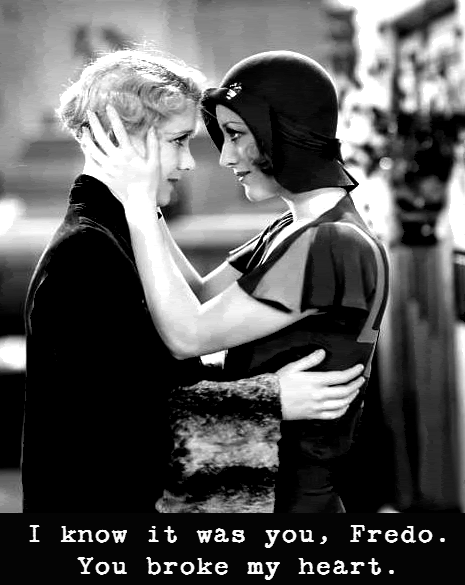
Our Dancing Daughters revolves around the romantic foibles of three well-to-do young ladies -- Diana (Joan Crawford), Beatrice (Dorothy Sebastian) and Ann (Anita Page). Diana and Ann have both set their sights on Ben Blaine (Johnny Mack Brown), but Ann manages to snatch him up first, much to Diana's chagrin. Melodrama ensues.

Diana is very much a character of the era -- the seemingly wild flapper who is actually quite virtuous. Ann, meanwhile, is a dipsomaniac and a gold-digger, interested in Ben for his money as much as his good looks. Of the three girls, however, it is Beatrice who is the most interesting. She is a faithful friend to Diana and very much in love with a dashing young fellow named Norman (Nils Asther), but at the same time she is haunted by certain misdeeds in her past (it isn't revealed precisely what these misdeeds are, but we may infer with some confidence). Beatrice does marry Norman, although her troubled past causes some difficulty for the married couple. While it's true that the primary focus of the picture is the Diana-Ben-Ann love triangle, the Beatrice sub-plot is intriguing in its own right (it's unfortunate that it was not fleshed out a little more, I think). In any event, Diana and Ben do eventually wind up together, after Ann is removed from the picture by means of a drunken tumble down a flight of stairs.

With all of that said, the question remains -- is it a good picture? In all honesty, it probably depends on your criteria. As you might imagine from the synopsis offered above, Our Dancing Daughters is a bit thin in terms of character development and plot. On the other hand, it's certainly a well-photographed picture, and the art direction is top-notch -- everything from the set design to the costumes is absolutely lovely, oozing with 1920s awesomeness. Indeed, the very fact that it is such a product and such a relic of its time is what makes Our Dancing Daughters so interesting to watch (notwithstanding the fact that it features three of my favorite actresses). Perhaps it isn't a classic masterpiece of American cinema, but I enjoyed watching it, and I imagine most others interested in the era would enjoy it as well. If nothing else, Our Dancing Daughters must rank highly on my list of guilty pleasures.

04 February 2010

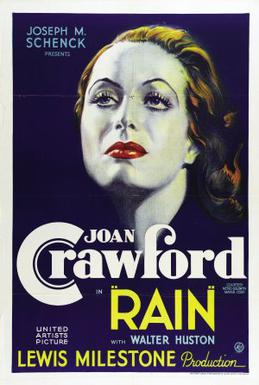
Rain (1932)


Released in 1932 by United Artists and directed by Lewis Milestone, Rain stars Joan Crawford as Sadie Thompson, a woman with a decidedly checkered past. Opposite her is Walter Huston in the role of Reverend Alfred Davidson, a stalwart Christian fundamentalist who is hellbent on saving Sadie's soul (whether she likes it or not).

There's rather a lot to like about this picture. Although it dates from a period in film history when talking pictures were really only just beginning to hit their stride, Rain is largely able to avoid many of the problems that seem to plague many movies of the era -- the acting is hardly stiff, the sound quality is quite good (for 1932, at any rate), and the camera work is anything but static. Indeed, Lewis Milestone's camera work is one aspect of the film that really stands out -- in addition to some shots that suggest the art house more than the studio-owned movie theater, Milestone incorporates some unusually long tracking shots (at least for the time) even one instance where the camera completely circumnavigates the action (an almost cliched cinematographic trope these days, but perhaps fairly innovate for 1932). I imagine that being free of studio constraints afforded Milestone a bit of creative latitude -- it has to be said that United Artists was the closest thing there was to an indie-film distributor in the era of the studio system. None of this might be particularly groundbreaking, but I have rarely seen such techniques in pictures from the time, which allows Rain to truly stand out from the crowd.

Beyond all that, Rain is also an exceptionally well-written picture. The screenplay is based on a 1923 stage play of the same name, which was in turn based on the 1921 short story "Miss Thompson" by W. Somerset Maugham, which was later retitled "Rain" (remember that bit of trivia for your next A/V Club meeting). Not only does the picture deal with such themes as moral ambiguity and religious hypocrisy -- two of my favorites, as you might have guessed -- but it does with a pair of genuinely interesting and well-developed characters. The only drawback is that many of the more sordid elements of the plot are only hinted at or alluded to (but such, unfortunately, is the nature of 1930s Hollywood).

More than anyone else, Joan Crawford is perhaps the biggest beneficiary of the strong screenplay. Sadie Thompson is much more profound character than the majority of characters that Joan played during her career -- this role certainly has Janie Barlow and Crystal Allen beat by miles, to say nothing of that one movie with the ice-skating -- and she actually does a hell of a job, particularly during Sadie's fits of rage at Reverend Davidson. In all honesty, I think Joan's Sadie Thompson gives her Mildred Pierce a run for its money.

Of course, fanboyism should not keep me from giving Walter Huston his due. Walter is great as the sanctimonious Reverend Alfred Davidson, looking and sounding every bit the seemingly self-possessed bible-beater. Towards the end of the movie, when the Reverend gives in sinful temptation, Walter metamorphoses from pious preacher to creepy lecher extremely well, and all with a shift in facial expression. Once again, a hell of a performance.

Yet in spite of all this, Rain was a critical and commercial failure at the time of its release. Joan took this reaction to heart, sticking to safer and more accessible roles for the remainder of the decade. Truly unfortunate, since Rain does demonstrate that she could be quite an actress if given decent material. Fortunately for posterity, however, the picture has attained much greater renown today, and is generally counted among Joan's best pictures.

For classic movie junkies, it's definitely worth checking out. Movie lovers in general might also want to give it a go, if only to see how it stacks up against other movies of the era. And if you don't have TCM or don't want to fork over the cash for a DVD, you can even watch Rain in its entirety on the Internet Archive. It turns out that the internet is good for something other than porn, after all!

17 September 2009

Am I Late for this Party?


... Who are you, and who let you in here?

05 August 2009

Free Associations, Ep. 10

Now just you put that bat down and hear me out on this.

Perhaps the similarities lie not so much in the characters of Ren and Stimpy themselves, but in a particular episode. In the episode Stimpy's Fan Club, it is revealed that Stimpy is by far the more popular of the duo, receiving scores of fan letters whilst Ren receives not a single one. Ren is quite hurt by this, so Stimpy attempts to make him feel better by apointing him president of the Stimpy Fan Club. This only forces Ren to read more and more of Stimpy's fan mail, which begins to drive him insane.

Ren's anger and resentment boils over in what has to be one of the most unsettling sequences ever included in what was allegedly a cartoon for kids. As he watches Stimpy sleep, Ren launches into a psychotic monologue and plots to kill Stimpy. He plans to snap Stimpy's neck, but suffers a rather graphic nervous breakdown before the deed can be carried out. The next morning, Ren disguises himself as Stimpy, and tells the mailman not to deliver any more fan mail. The mailman, however, only has one fan letter and it is for Ren. Ren viciously taunts Stimpy as he reads his fan letter aloud, only to find out that the letter was from Stimpy himself. Ren feels like a total ass, and Stimpy, ever the magnanimous one, forgives Ren.

To me, this seems like a fairly accurate parallel to the respective careers of Joan and Dorothy--the dumb one (Joan) became immensely popular while the smart one (Dorothy) suffered in obscurity. And although it (probably) never happened, the image of Joan and Dorothy doing the Happy, Happy, Joy, Joy dance is so silly that it actually causes me physical pain.

10 June 2009

A Sure Sign of Obsession

I fell asleep extremely early last night, with the result that I had many quite vivid dreams. One of these took the form of a picture that starred Norma Shearer, Joan Crawford, Myrna Loy and Clark Gable (rather an ensemble cast, to say the least). As is so often the case with dreams, the details are sketchy, but I do remember that Myrna Loy was some sort of con-artist-cum-jewel thief, and Norma Shearer was the intended victim. What role Joan Crawford and Clark Gable played is somewhat less clear, but I'm fairly certain that they would have struck up a romance that would have complicated Myrna's diabolical schemes in some way or another.

There was also a merry-go-round involved, but I'm not sure that that detail doesn't make things even more confusing.

Ultimately, I am left with two nagging, unanswered questions: Why wasn't this movie ever made? And why can't I have more dreams like this?

04 May 2009

Enchanted Faces


A few of my favorites from illustrator Bob Harmon's Enchanted Faces series of portraits.

23 March 2009

Free Associations, Ep. 9: Special Birthday Edition

Joseph Vissarionovich Stalin and Joan Tomasovna Crawford are famous for vastly different things--one ruled the Soviet Union with an iron first while the other was the quintessential movie star of Hollywood's Golden Age. To most, that is where the similarities end. That, however, is not quite the case.

In their younger and more vulnerable days. Actually, I think they make quite a cute couple.

To begin with, Stalin and Crawford were both noted for their willfulness, argumentativeness and assertiveness. In fact, give the tireless way they clawed their way up the ranks of their respective professions, it wouldn't be stretching the truth too far to say that Stalin and Crawford both possessed a particular forms of megalomania. Although the difference between dictatorship and movie stardom necessitates that Uncle Joe and Mommie Dearest manifested their megalomania in different ways, there is little doubt in my mind that their eccentricities both sprang from the same intrinsic need to be great.

The remorseless way in which Stalin and Crawford pursued their respective forms of greatness meant that they both made their fair share of rivals and opponents. Stalin had many nemeses (real or otherwise) in the early days of the Soviet Union, most notably Sergei Kirov and Leon Trotsky, while Crawford viewed Norma Shearer as a hated rival, and later feuded quite famously with Bette Davis. Stalin's enemies usually wound with a bullet (or the occasional ice axe) through the brain, but Joan never quite had the luxury of being able to arrange for her enemies to meet with unpleasant ends (this is probably for the best--Norma Shearer's bullet-riddled corpse, no doubt, would have been the source of quite a scandal for the gossip rags of the day).

Stalin and Crawford were both highly conscious of how the public perceived them, though their dealings with the little people were not necessarily the same. Joan was keen to the fact that her greatness was dependent upon the approval and adulation of her fans, and sought to always stay in their good graces. Ever less nuanced in his ways, Stalin dealt with the problem by ensuring that the people of the Soviet Union knew of no alternative but to adore him. Stalin's cult of personality will remain the envy of dictators and generalissimos for centuries to come (In a way, a cult of personality for Joan has survived to this day, but it seems that most members of this particular cult are drag queens).

Nor are the personal lives of Joseph Stalin and Joan Crawford without their similarities. It should come as little surprise that they each had rough childhoods. Beyond that, however, their relationships with their families were, shall we say, a bit strained. Joan's dominion paled in comparison to Stalin's--the Crawford household was hardly the size of the Soviet Union--but what she did control she ruled with an iron fist. Indeed, Christina Crawford's Mommie Dearest is a retelling of Joan's totalitarianism. It's not quite The Gulag Archipelago, but I suppose that it springs from a similar (albeit much less bloody) sort of victimization.


After their rise to power.

No one can say for sure what Josef Stalin would have been like in Hollywood, nor can anyone be sure what Joan Crawford would have done at the helm of a totalitarian dictatorship. I suspect, however, that the end results wouldn't be all that different.

And if you didn't know, it's Joan Crawford's birthday. Merry Joansmas to all!

27 January 2009

Dueling Musicals, Part II: Dancing Lady (1933)

When last we met, Warner Bros. had unleashed a series of highly successful musical films over the course of 1933. Metro-Goldwyn-Mayer, meanwhile, had not attempted a major musical since 1930; The March of Time (which was scrapped before production was complete) and Lord Byron of Broadway (which bombed at the box office) were both produced that year. With hostilities reopened on the musical front, MGM needed to hit back in a major way. To that end MGM released Dancing Lady in November of 1933. The picture was a hit at the box office, and proved to be just the counter-stroke that MGM needed--the Operation Uranus to Warner Bros. Case Blue, if you will (is that a dense enough metaphor for you?).

Dancing Lady is the story of Janie Barlow (played by Joan Crawford), a burlesque showgirl who decides to have a go at legitimate theater after her previous show is broken up by the police. She is bailed out by Tod Newton (Franchot Tone), one of those Park Avenue types you hear so much about, and who clearly fancies Janie (and who can blame him?). Janie attempts to get the attention of veteran Broadway director Patch Gallagher (Clark Gable), but to no avail. Tod again helps Janie out by agreeing to finance Patch's production on the condition that Janie be given a place in the show. A typical Joan Crawford love triangle ensues (along with a few plot points that I, to be perfectly honest, don't feel like recounting), but after all the sound and fury Janie ultimately winds up as the leading lady. By the way, does that sound familiar?

For a variety of reasons, I enjoyed Dancing Lady, perhaps more than a sane person ought to. The most obvious reason is none other than Joan Crawford herself, who (aside from being stunningly gorgeous) is fantastic throughout the whole picture. Indeed, Dancing Lady is almost a biographical sketch of Joan, who--like her character--rose from the rank of a mere chorus girl to a top-tier starlet. Though her singing voice may leave something to be desired, Joan dances well enough and is quite endearing as a comedienne. If 42nd Street was Ruby Keeler's ticket to stardom, Dancing Lady cemented Joan's position in the Hollywood firmament; so great was her success in the picture that Dancing Lady remained a de facto measuring stick for her subsequent roles at MGM.

Now that I have sufficiently fawned over Joan Crawford, let us consider a few of the other players in the film. Dancing Lady was the fourth film in which Clark Gable played Joan's leading man (they ultimately made eight films together). In this picture, Clark Gable is... well, Clark Gable. He does what he always does, and does it as well as he always does. Franchot Tone makes quite a good Park Avenue chap, perhaps because he was one off the screen as well as on. Ted Healy and his stooges--the Moe, Larry and Curly of legend--also make an appearance as stage hands, still at the beginning of their Hollywood careers at this point. At the same time, this picture was one of the last appearances of Winnie Lightner, who appeared in several early talkies at Warner Bros. before attempting (unsucessfully, sadly) to freelance. Finally--and perhaps most interestingly--Dancing Lady marks the film debut of Fred Astaire, who serves as Joan's dance partner in the picture's musical finale.

Ironically, neither Fred Astaire nor the Stooges would stay with MGM for long after Dancing Lady. The Stooges made a few shorts at MGM before moving on to greater fortunes at Columbia. Fred Astaire, meanwhile, was under contract to RKO Pictures and had been loaned out to MGM for Dancing Lady. Had the studio heads at MGM forseen the kind of success these two short-timers would have down the road, they no doubt would have forked over heaps of money to keep them in the MGM stable of stars. It is quite a twist of fate that Dancing Lady was produced by David O. Selznick, who had signed Fred Astaire to RKO before returning to produce pictures at MGM in the stead of an ailing Irving Thalberg (come on, you think this shit is interesting, too!).

For all the hits MGM and Warner Bros. rolled out that year, the battle for musical supremacy was hardly decided in 1933. Warner Bros. produced a series of Gold Diggers pictures, with installments in 1935, 1936 and 1938*. Not to be outdone, MGM produced the Broadway Melody series, with iterations in 1935, 1937 and 1940*. Picking a winner is largely a subjective matter, but two important factors must be considered. First of all, MGM managed to remain profitable throughout the Depression while Warner Bros. (not to mention the rest of Hollywood) failed to do so. Second, MGM continued to crank out musicals during the 1940s and 1950s, giving rise to the likes of Gene Kelly. Ultimately, it seems that MGM was victorious on the musical front, and Dancing Lady was doubtless a considerable factor in that victory.

*Note that I am going by the year the films were produced, not by the years in the title.

15 January 2009

The Godflatmate

Some time later, she was found floating in Long Island Sound.

24 October 2008

Come Again?

And just what are you insinuating, Turner Classic Movies? I know she wasn't the most stable personality in Hollywood, but that's a bit far-fetched, even for me. Then again, who knows what deep, dark secrets those big eyes were hiding?

P.S. Yes, yes, I know she plays a murderer in Strait-Jacket. But doesn't the insertion of biographical short into a block of films about psycho killers seem a bit incongruous to anyone else? ...Maybe not.

18 August 2008

Free Associations


Whatever, it makes perfect sense to me.

17 April 2008

Relevant to my Interests, Ep. 10

Dorothy Sebastian, Joan Crawford and Anita Page show off the goods in a promotional shot from 1928's Our Dancing Daughters. I need to see this film before I die. Not necessarily because it is a masterpiece of cinema, mind you, but because I am a terrible fanboy. If I have to buy a VCR just so I can watch it on VHS, then so be it. It's a sacrifice I'm willing to make, dammit.

At this juncture I am so very tempted to analyze the significance of Joan's character being named Diana, after the Roman goddess of the hunt (who was also a virgin, by the way). I am equally tempted to engage in an unnecessary exegesis of Dorothy's playing a character named Beatrice (the name of the woman with whom Dante Alighieri, the greatest poet in all of western literature, was smitten throughout his life). Despite those temptations, I will refrain. I needn't give the reader any further evidence that I am truly crazy.

23 March 2008

Ave Ioanna, Imperatrix Totius Mundi!

Today is the birthday of no less a personage than the inimitable Joan Crawford (née Lucille LeSeuer). By way of celebration, I've whipped up a bit of pro-Joan propaganda. There's not much I can say about the occasion or Joan herself that hasn't already been said by others more knowledgeable and more eloquent than I am, so rather than make small talk let's all pour one out for our dead homie.

As an aside, here's what the Blue Öyster Cult has to say about the matter.

24 February 2008

The Women (1939)

Few movies are as true to their titles as is The Women. There's not a Y chromosome in the entire film. Not that I minded terribly; men can be very annoying, and I found myself glad to be rid of them while watching this movie.

The Women follows the story of socialite Mary Haines, whose husband, unbeknown to her, has been unfaithful to his wife (to put it blithely), seeing perfume saleswoman Crystal Allen on the side. Hilarity ensues as, thanks to a loose-lipped manicurist, Mary learns of her husbands extracurricular activity, and files for a divorce. Mary's so called friends, among them the odious Sylvia Fowler, delight in her downfall, wretched gossips that they are. Of course, this being 1939, everything works out in the end, with everyone getting their just desserts.

Mary Haines is played by Norma Shearer, who gives an admirable and sympathetic performance of the wronged wife. Joan Crawford plays Crystal, the gold-digging homewrecker par excellence, and she turns in quite a performance (although her hairdresser, it must be said, deserves a traitor's death. Joan sports a rather unflattering coiffure throughout the flick, sad to say). The two work extremely well as rivals in the film, since they were fierce studio rivals at MGM in the 1930s, and probably hated each other. Seriously, there's a cat fight that I'd pay good money to see.

The character I really loathed (as I no doubt was supposed to) was Sylvia Fowler, played well by Rosalind Russel. Russel does a fine job of being a manipulative, obnoxious, conniving shrew--I wanted to backhand Mrs. Fowler no fewer than a half-dozen times.

The film is in black and white, with the exception of a Technicolor fashion show, apparently inserted into the movie with the sole purpose of showing off the haute couture of costume designer Adrian. This, I thought, was a bit much, and I can understand why the sequence isn't always included in showings of The Women. On the other hand, it was enjoyable to see some of the incredibly gaudy outfits, some of which I can't possibly imagine any respectable woman wearing, even back in the day. Of course, The Women was produced on the even of the 1940s, and I find 40s styles in many ways atrocious, especially when it comes to women's hairstyles.

As a personal note, I was glad to see Dorothy Sebastian back on screen, even if hers was only an uncredited, bit part. I could barely recognize her with blond hair (which, I might add, was done up in hairdo on par with Joan's. I don't know who was responsible for styling the hair in this movie, but they are dire need of a beating).whoops, never mind that part.

I rather enjoyed The Women. I found the recurring references to Jungle Red particularly amusing, especially Mary's remark about her "claws" at the end of the movie. If I ever find myself leading an armored division into battle, rest assured that "Jungle Red" will be our battlecry.

And did I really just write several paragraphs arguing about costume design and hairstyles? Good God. Pardon me, but I have to go play some violent video games while listening to Death Metal.

18 January 2008

Vignettes of Absurdity: Hell's Cafeteria

It was just another routine lunch break in the cafeteria, when suddenly...

[Door flies open]

Norma Shearer: Am I famished! (shoves her way past everyone and skips to the front of the line) You there, peon! Give me your finest Penne all'arrabbiata, and try not to get any of your stink in it!

Barth: Excuse me, Miss, but there's a line.

Norma: A line? A line? Let me explain to you how this works. I don't have to stand in line! Don't you know who I am?

Barth: Are you Greta Garbo?

Norma: What!? How dare you mistake me for that Swedish dildo licker! I'm Norma Shearer!

Barth: Oh, are you married to Jeff Shearer?

Norma: Who in the name of God is Jeff Shearer?

Barth: He's head of catering.

Norma: Catering? I could kill catering with a thought! Now start shoveling that slop onto a plate and hand it over, will you?

Barth: Well, you'll need a tray.

Norma: I don't need a tray!

Barth: No, you probably should get a tray.

Norma: Don't you dare tell me what to do! Nobody tells Norma fucking Shearer what to do, especially not some trouser stain cafeteria employee! I am a golden goddess given flesh, and you are but an ant in the afterbirth! I could snuff out your pathetic existence with a single glance! I could just as easily kill you with one of your damned trays by hacking at your neck with the thin bit until the blood flows across the canteen floor, if I so chose! So don't you dare tell me I need a tray!

Barth: No, I mean the food's hot, and you'll want a tray to carry it.

Norma: ...oh. (reaches for a tray) This one's wet. And this one's wet. And this one's wet! DAMNATION! I WILL KILL EVERYONE IN THE WORLD! IRVING! PULL UP THE HUMMER! (Storms out the door, frothing at the mouth)

Barth: God damnit, I hate my job. This day can't possibly get any worse.

[Door flies open]

Joan: (stumbles in, carrying an almost-empty 40 oz. of Olde English 800) HEY MOTHAFUCKAS! Y'ALL BETTA RECOGNIZE!

Barth: Oh dear Lord, I spoke too soon.

{Fin}

I owe apologies to Eddie Izzard for stealing his jokes. but you see, I just couldn't help it.

03 January 2008

Vignettes of Absurdity: Royale With Cheese

Dorothy: Hey Joan, you know what they call a Quarter Pounder with Cheese in Paris?

Joan: They don't call it a Quarter Pounder with cheese?

Dorothy: No man, they got the metric system. They wouldn't know what the fuck a Quarter Pounder is.

Joan: Then what do they call it?

Dorothy: They call it a Royale with cheese.

Joan: A Royale with cheese. What do they call a Big Mac?

Dorothy: Well, a Big Mac's a Big Mac, but they call it le Big-Mac.

Joan
: Le Big-Mac. Heh. What do they call a Whopper?

Dorothy: I dunno, I didn't go into Burger King.

22 December 2007

Things I Want for Christmas


Of course failing that, I wouldn't mind an Xbox 360. Or maybe some social skills.

15 December 2007

Relevant to my Interests, Ep. 5 (2-for-1 Special!)

Egads, have I really gone an entire month without posting about Joan Crawford? For Shame! As penance for this egregious blasphemy, here are two pictures. First an early picture, but one of my absolute favorites.

And here's a second which, judging by the caption, dates from around 1929-30.