
Norma Shearer has nobody to kiss her under the mistletoe. I know I would.

 With the exception of my bargain-bin copy of Nosferatu, the first proper silent movie I ever watched was 1927's The Student Prince in Old Heidelberg. In retrospect, I could not have asked for a better introduction to that era of film making. With a great cast, superb direction, top-notch production values and nary a word of spoken dialogue, The Student Prince is one of the primary examples of just how great silent movies could be.
The Student Prince in question is Karl Heinrich of the fictional kingdom of Karlstadt, played here by Ramon Novarro (in the films first few scenes, the Prince is played as a boy by Phillipe De Lacy). Karl Heinrich is stuck in the stifling rigidity of court life, his only friend being his kindly tutor Dr. Jüttner (Jean Hersholt). Upon the completion of his primary education, Karl Heinrich in granted leave to complete his studies in the picturesque city of Heidelberg with Dr. Jüttner as his chaperon. In Heidelberg Karl Heinrich tastes freedom for the first time, carousing and tossing back steins of beer with the vivacious cadets of the Corps Saxonia. Most importantly, however, Karl Heinrich meets a beautiful barmaid named Kathi (Norma Shearer), and the two fall truly, madly and deeply in love.
In some of the most beautifully shot scenes in the film, Karl Heinrich and Kathi share a positively idyllic romance. Their bliss comes screeching to a halt, however, when Karl Heinrich receives news that the king of Karlstadt has fallen terminally ill and is compelled to return home. With the king on his deathbed, Karl Heinrich is forced to chose between his duty to Karlstadt and his love for Kathi.
Although the plot is far from groundbreaking, the picture is so well put together that what in other hands would be a strictly formulaic affair is quite touching. The film was produced at the very height of the silent era, and it shows. This is due, in large part, to the the excellent direction of Ernst Lubitsch, who amply demonstrates in The Student Prince his singular talent as a director of romantic pictures. Norma Shearer is as charming as ever as Kathi, and Jean Hersholt is particularly likable as Dr. Jüttner. Ramon Novarro carries the picture quite well, giving a highly sympathetic performance as Karl Heinrich.
One thing that really enhances the viewing experience is the musical accompaniment. One wouldn't normally expect that from a silent film, but here is one area where the march of time has worked out to our advantage. The print which TCM usually shows is accompanied by a full orchestral score, composed by Carl Davis and performed by the London Philharmonic Orchestra. Davis has composed new scores for several silent films, including Ben-Hur, The Big Parade and Phantom of the Opera, to name a few. Davis' score is a perfect counterpart to the picture, and the man deserves mad respect for his contributions to the survival of silent films.
I just recently saw The Student Prince in Old Heidelberg for the third time, and I found that I enjoyed it just as much as the first time (if not more so, now that I have become a bit more learned in the ways silent pictures). Although it has been released on VHS, The Student Prince is not yet available on DVD (here's hoping it will see a release through the Warner Archive collection before too long). Fortunately, the film airs on TCM with relative regularity. I strongly recommend watching The Student Prince in Old Heidelberg the next time you get a chance.
[Poster via Dr. Macro]
 I'd like to know what led to this meeting of Jean Arthur and Norma Shearer in their younger and more vulnerable days. Was it some sort of neck-wear convention? The world may never know.

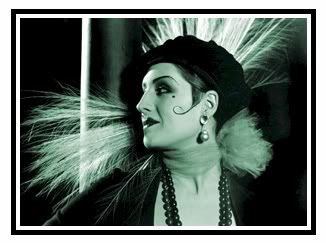 Lady of the Night is, for all intents and purposes, a vehicle for Norma Shearer, still a relative newcomer and a nascent star in 1925. Norma plays two characters of of decidedly different backgrounds--on the one hand is Florence, a respectable daughter of a judge and a society darling, and on the other is Molly, a girl who was raised on the mean city streets. Another interesting contrast between the two girls is the fact that Florence grew up without a mother, while Molly grew up without a father (we see Molly's father hauled off to jail at the beginning of the picture, having been proclaimed guilty by none other than Judge Banning, Florence's father). By a cruel twist of fate, Florence and Molly both fall in love with the same man, a successful inventor named David Page (played by Malcolm McGregor, who, by the way, was a native of Newark, New Jersey). The situation is complicated by the fact that Molly was previously entangled in a shaky relationship with David's friend "Chunky" Dunn (played by George K. Arthur). Although Molly spurns him in favor of his more successful and more handsome friend, Chunky nevertheless tirelessly venerates her.
 Lady of the Night was quite a pleasant surprise for me--it exceeded my expectations rather greatly. I wouldn't go so far as to call it a masterpiece of the cinema, but it nevertheless was a delight to watch. It also helps that Norma Shearer is rather pleasant to look at, especially when she appears as Molly; despite--or perhaps because of--Molly's somewhat trampy makeup, she is disquietingly beautiful (evidence of this can be seen on the right). But I digress. For fans of silent film, I can recommend Lady of the Night without a hint of hesitance.
 Few movies are as true to their titles as is The Women. There's not a Y chromosome in the entire film. Not that I minded terribly; men can be very annoying, and I found myself glad to be rid of them while watching this movie.
 Norma Shearer was America's lazy-eyed sweetheart; the de facto imperatrix of Metro-Goldwyn-Mayer during the 1930s. It helped that she was married to producer Irving Thalberg, a fact her studio rivals--chief among them Joan Crawford--were wont to dwell on. Of course, Norma was a perfectly good actress in her own right, and wielded great influence in Hollywood until her impromptu retirement in 1942.
 It was just another routine lunch break in the cafeteria, when suddenly...
 Norma Shearer: Am I famished! (shoves her way past everyone and skips to the front of the line) You there, peon! Give me your finest Penne all'arrabbiata, and try not to get any of your stink in it!
 Barth: Excuse me, Miss, but there's a line.


